

Table of Contents
Why the Azores Are Ideal for Slow, Family-Centered Travel
A destination built for curiosity, not crowds

When you plan Azores holidays with a family-first mindset, you are choosing a destination that naturally rewards curiosity, patience, and time outdoors. The Azores archipelago sits far from mass-tourism circuits, which translates into quieter towns, less commercial pressure, and landscapes that feel intact rather than curated. This matters when traveling with children. You are not rushing between attractions or competing with crowds; instead, you can move at a pace that allows kids to observe, ask questions, and engage deeply with their surroundings.
For families seeking Azores with kids experiences that feel authentic rather than packaged, the islands offer a rare balance: well-developed infrastructure paired with a strong emphasis on nature, conservation, and local life.
If you have any comments/questions, please leave them below.
Why slow travel works especially well in the Azores
Slow travel is not a trend in the Azores; it is the default rhythm of the islands. Ferries run on weather, hikes are shaped by terrain rather than timetables, and many of the most memorable experiences require waiting, watching, and adapting. For adventurous families, this creates a learning-rich environment.
A slow-travel approach to Azores holidays allows you to:
- Spend multiple days exploring one region rather than checking off islands
- Adjust plans based on weather, energy levels, and sea conditions
- Build rest days into your itinerary without feeling like you are missing out
- Let children engage repeatedly with the same landscapes, which deepens understanding
This approach aligns especially well with families who prioritize outdoor learning, resilience, and flexibility over rigid schedules.

A natural classroom for outdoor and environmental learning
One of the strongest reasons families choose the Azores with kids is the sheer density of real-world learning opportunities. The islands are shaped by active volcanism, Atlantic weather systems, and marine ecosystems that are visible, tangible, and constantly changing.
As you travel through the Azores, children can encounter:
- Volcanic craters, lava fields, and geothermal activity
- Coastal cliffs, tide pools, and natural swimming areas
- Endemic plant species and protected forest habitats
- Whale and dolphin migration routes in open ocean
These are not abstract concepts presented in museums alone; they are landscapes you walk through, swim beside, and observe daily. This makes the Azores especially compelling for families interested in educational travel, nature-based learning, and adventure travel with kids.
For background on how these geological and ecological systems are protected, you can reference the Azores’ designation within UNESCO’s Global Geoparks network.
Safety, infrastructure, and family practicality
Choosing a destination for Azores family travel also requires practical reassurance. The Azores are part of Portugal and benefit from European safety standards, reliable healthcare access, and stable infrastructure. Roads are generally well maintained, towns are compact, and distances between activities are manageable when you plan thoughtfully.
From a family planning perspective, this means:
- Access to modern hospitals and clinics on the main islands
- Safe drinking water and food standards
- A culture that is generally welcoming and patient with children
- Low levels of violent crime and heavy traffic compared to many global destinations
These factors allow you to focus on exploration and learning rather than constant logistical stress, which is especially important when traveling with younger children.
How the Azores compare to mainland Portugal for families
While mainland Portugal offers historic cities and faster-paced itineraries, Azores holidays tend to suit families who value immersion over variety. The islands trade urban density for open space, and nightlife for nature. If your goal is outdoor adventure, environmental learning, and unstructured play in dramatic landscapes, the Azores often align better with that vision than city-based itineraries. Small group tours are an excellent way to experience the Azores.
For families deciding between destinations, the Azores stand out as a place where slowing down is not a compromise but an advantage, particularly when traveling with kids who benefit from repetition, routine, and room to explore.
Planning Azores Holidays With Kids: Logistics That Matter
When to go for family-friendly conditions
Timing plays a major role in how successful your Azores holidays will feel when traveling with children. The Azores have a mild, maritime climate year-round, but weather variability is a defining feature. Clouds, wind, and rain can move quickly, sometimes within the same day.
For most families, the most practical window is late spring through early fall.
- Late May to June offers greener landscapes, fewer crowds, and improving ocean conditions
- July and August provide the warmest water temperatures and the most predictable ferry schedules, but also higher prices and more visitors
- September is often ideal for Azores with kids, combining warm seas with quieter towns and shoulder-season pricing
Winter travel is possible, but frequent storms, rough seas, and shorter daylight hours can complicate outdoor plans, especially if you are traveling with younger children.
For long-range planning and realistic expectations, consult official climate data from Portugal’s meteorological service.
Getting to the Azores and moving between islands
Most families arrive via Ponta Delgada on São Miguel, the largest island and the primary international gateway. Direct flights are available seasonally from North America and year-round from mainland Portugal. If you are traveling with children, minimizing flight connections and island hops will significantly reduce fatigue.
Once in the archipelago, inter-island travel happens by small planes or ferries. While island hopping can be appealing, it adds logistical complexity.
When planning Azores family travel, consider:
- Staying on one island for trips under 10 days
- Limiting island changes to one transfer for longer stays
- Avoiding tight ferry connections, which are weather dependent
- Treating travel days as low-expectation days for kids
For up-to-date transport routes and schedules, SATA Azores Airlines is the authoritative source for inter-island flights.
Renting a car versus public transportation
For families exploring the Azores with kids, renting a car is usually the most practical choice. Public transportation exists but is limited in frequency and coverage, particularly for trailheads, hot springs, and rural viewpoints.
A rental car allows you to:
- Adapt plans quickly based on weather
- Reach outdoor sites early or late in the day
- Carry child gear, snacks, and extra clothing
- Avoid long waits between connections
Compact cars are common, but availability can be tight in summer. Booking well in advance is essential for Azores holidays during peak season.
Where to stay with children
Accommodation choice has a significant impact on how relaxed your trip feels. The Azores offer a wide range of small-scale lodging rather than large resorts, which often suits families seeking slower travel.
Family-friendly options commonly include:
- Rural guesthouses with outdoor space
- Apartments or self-catering cottages
- Small hotels in walkable town centers
When traveling with kids, prioritize places that offer easy parking, laundry access, and flexibility around meals. Staying slightly outside major towns can also reduce noise and improve access to nature, as long as you are comfortable driving.
For independent evaluations and practical neighborhood guidance, Lonely Planet provides a reliable, non-commercial overview of accommodation patterns across the islands.
Planning pacing and expectations
One of the most common mistakes families make when planning Azores holidays is overloading the itinerary. Distances may look short on a map, but winding roads, elevation changes, and weather delays slow everything down.
A realistic planning framework for Azores with kids includes:
- One major outdoor activity per day
- Built-in buffer time for weather changes
- Regular rest days with minimal driving
- Repeating favorite activities rather than constant novelty
This pacing supports children’s energy levels and allows you to experience the Azores as a place to inhabit, not just observe.
By grounding your logistics in flexibility and restraint, you set the foundation for a trip that feels both adventurous and sustainable for the entire family.
Learning Through Travel: Raising Curious Explorers in the Azores
Why the Azores support experiential learning
Azores holidays naturally lend themselves to learning through observation, movement, and inquiry rather than structured instruction. The islands function as an open system where geology, ecology, weather, and human adaptation are visible in everyday life. For families traveling with intention, this creates consistent opportunities for children to connect abstract concepts to real environments.
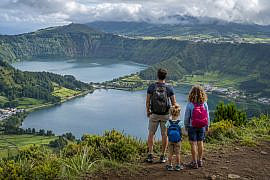
Instead of separating sightseeing from learning, Azores with kids experiences tend to merge the two. A coastal walk becomes a lesson in erosion and wave energy. A volcanic crater lake opens conversations about plate tectonics and water cycles. These moments are not dependent on prior expertise; they emerge from place-based exposure and guided curiosity.
Geography and geology as living lessons

The Azores sit along the Mid-Atlantic Ridge, and that geological reality shapes nearly every landscape you encounter. This makes the islands especially well suited for children who learn best through tangible examples.
Learning themes you can explore naturally include:
- Volcanic formation, lava flows, and crater lakes
- Geothermal energy and its everyday uses
- Earth’s tectonic plates and seismic activity
- Soil fertility and how it supports agriculture
You do not need to turn these experiences into formal lessons. Simple observation, followed by age-appropriate questions, often leads to deeper understanding than worksheets alone.
For accurate background context on the geological significance of the islands, the Azores UNESCO Global Geopark provides authoritative information.
Ecology, conservation, and environmental awareness
Azores family travel also introduces children to conservation as a lived practice rather than a theoretical concept. Much of the archipelago is protected land or marine area, and conservation policies shape how visitors interact with nature.
As you travel slowly through the islands, children can observe:
- Endemic plant species found nowhere else
- Protected marine habitats and whale migration routes
- Sustainable farming practices adapted to island conditions
- Human impacts on fragile ecosystems
These encounters help frame environmental responsibility as practical and ongoing, not abstract or distant.
Balancing digital tools with hands-on exploration
While the Azores strongly encourage outdoor engagement, many families still seek ways to integrate structured learning during travel downtime. Long ferry rides, weather days, or quiet evenings can be ideal moments to reinforce problem-solving and creative thinking.
In these contexts, thoughtfully chosen digital tools can complement physical exploration. Platforms that focus on logic and creativity, such as coding for kids, can provide short, purposeful activities that align well with the broader goal of nurturing curiosity rather than passive consumption.
Used intentionally, these tools support cognitive development without displacing outdoor experience.
Encouraging curiosity without over-structuring
One of the most valuable aspects of Azores holidays with kids is the opportunity to step back from over-programming. The environment itself invites questions, experimentation, and independent discovery.
To support this style of learning:
- Allow children to revisit the same places multiple times
- Encourage journaling, sketching, or photography instead of constant instruction
- Ask open-ended questions rather than offering explanations immediately
- Let uncertainty and weather changes become part of the learning process
This approach aligns well with slow travel principles and helps children develop adaptability, observation skills, and intrinsic motivation to learn.
By viewing the Azores not as a checklist of attractions but as a dynamic learning environment, you create space for meaningful growth that extends well beyond the trip itself.
Outdoor Adventure Experiences in the Azores With Kids
Why outdoor adventure defines Azores holidays
Outdoor experiences are not an optional add-on when planning Azores holidays; they are the foundation of how families engage with the islands. The Azores are shaped by volcanic terrain, Atlantic weather, and a strong conservation ethic, all of which encourage active exploration rather than passive sightseeing.
For families traveling to the Azores with kids, outdoor adventure tends to be immersive, varied, and scalable. Many activities can be adapted for different ages and energy levels, making it possible to include children without compromising safety or depth of experience.
Hiking and walking in volcanic landscapes

Hiking is one of the most accessible ways to experience the Azores as a family. Trails range from short coastal walks to longer routes through crater rims and forested interior regions.
When planning hikes with children, prioritize:
- Clearly marked trails with manageable elevation gain
- Loop routes or point-to-point walks with flexible turnaround options
- Coastal and lake paths where terrain is less technical
- Trails that allow frequent stops for observation and rest
Many routes pass through protected landscapes where children can observe lava formations, hydrangea-lined paths, and changes in vegetation with altitude.
For official trail classifications and safety guidance, consult the Azores Tourism trail database.
Whale and dolphin watching as a family activity
The Azores are one of the most important whale-watching destinations in the Atlantic, and marine life encounters often become a defining memory for families. Several species of whales and dolphins pass through the region throughout the year.
When traveling with kids, focus on operators that emphasize safety, education, and conservation.
Key considerations include:
- Choosing licensed operators that follow marine protection guidelines
- Confirming age recommendations and life jacket availability
- Preparing children for variable sea conditions
- Treating sightings as unpredictable wildlife encounters, not guaranteed performances
For guidance on ethical whale watching practices, the World Cetacean Alliance offers widely accepted standards.
Hot springs, geothermal sites, and natural swimming areas
Geothermal activity creates unique family-friendly experiences in the Azores, from warm ocean-fed pools to inland hot springs. These sites allow children to engage directly with volcanic processes in a controlled environment.
When visiting geothermal areas with kids:
- Follow posted temperature and safety warnings carefully
- Choose locations with gradual entry and stable footing
- Avoid areas designated for scientific or protected use
- Supervise closely, especially where water temperatures vary
These experiences combine sensory exploration with real-world science, reinforcing concepts children may already be curious about.
Coastal exploration, swimming, and tide pools
The Azores’ rugged coastline offers numerous opportunities for ocean-based exploration beyond traditional beaches. Natural swimming areas, sheltered coves, and tide pools allow families to engage with marine environments at close range.
Family-friendly coastal activities often include:
- Exploring lava rock tide pools at low tide
- Swimming in protected natural pools rather than open surf
- Observing fish, crabs, and algae in shallow water
- Learning how waves and tides shape volcanic coastlines
For safety and water quality updates, local municipal websites and Portugal’s coastal monitoring programs provide reliable information.
Adapting adventure to different ages
One of the strengths of Azores family travel is how easily outdoor experiences can be scaled. The same landscape can offer gentle exploration for younger children and more demanding challenges for older ones.
To keep adventures sustainable:
- Mix high-energy days with lighter exploration
- Allow children to opt out of longer activities without pressure
- Focus on shared discovery rather than endurance
- Treat weather changes as part of the adventure rather than setbacks
By grounding your itinerary in adaptable outdoor experiences, you ensure that Azores holidays with kids remain engaging, educational, and manageable for the entire family.
Where to Go: Best Azores Islands for Families
Why island choice matters for Azores holidays
Selecting the right island is one of the most consequential decisions you will make when planning Azores holidays with children. While the archipelago is often marketed as a single destination, each island offers a distinct balance of accessibility, activities, and logistical complexity. For families, especially those prioritizing slow travel and outdoor adventure, fewer islands usually lead to a more rewarding experience.
Rather than attempting to sample as many islands as possible, Azores with kids travel works best when you match island characteristics to your family’s pace, interests, and tolerance for transitions.
São Miguel: the most practical base for families
São Miguel is the largest and most developed island and often the easiest starting point for Azores family travel. It combines varied landscapes with strong infrastructure, making it especially suitable for first-time visitors traveling with kids.
São Miguel offers:
- Direct international flight access
- A wide range of accommodations suitable for families
- Short driving distances between major sites
- Volcanic lakes, hot springs, coastal walks, and whale watching from one base
For families who want a single-island itinerary with minimal logistical friction, São Miguel provides the greatest flexibility and variety.
Terceira: culture, walkability, and manageable scale
Terceira appeals to families seeking a balance between cultural exploration and outdoor activity. The island is smaller and flatter than São Miguel in many areas, which can make daily logistics easier with younger children.
Highlights for families include:
- A compact historic center in Angra do Heroísmo
- Walkable towns and accessible viewpoints
- Lava tube systems that support geological learning
- Less traffic and a slower overall rhythm
Terceira works particularly well for families who value cultural immersion alongside nature but do not need the breadth of activities found on São Miguel.
UNESCO provides authoritative context on Angra do Heroísmo’s cultural significance.
Pico and Faial: best for older children and longer stays
Pico and Faial are often paired in Azores itineraries, but they tend to suit families with older children or those traveling for longer periods. These islands emphasize dramatic landscapes, maritime history, and more physically demanding exploration.
Families considering Pico or Faial should be prepared for:
- Longer or more strenuous hikes
- Greater reliance on weather windows
- Fewer accommodation options compared to São Miguel
- A stronger focus on outdoor endurance and observation
These islands can be deeply rewarding for families comfortable with slower logistics and higher activity levels, but they are less forgiving for short trips with young children.
For practical ferry connections between islands, Atlânticoline is the official operator.
Should families island-hop in the Azores?
Island hopping can be appealing, but it often introduces unnecessary stress for families. Weather-related delays, packing and unpacking, and transit days can disrupt children’s sense of routine.
For most Azores holidays with kids:
- Trips under 10 days are best spent on one island
- Trips of two weeks may comfortably include two islands
- More than two islands often reduces depth without adding value
Choosing depth over breadth allows children to build familiarity with place, which enhances learning and emotional engagement.
Matching island choice to your family’s travel style
When deciding where to go, evaluate your priorities honestly.
Ask yourself:
- How many transitions can your children handle comfortably?
- Are you prioritizing hiking, wildlife, culture, or downtime?
- Do you prefer convenience or remoteness?
- How flexible can your plans be if weather shifts?
By aligning island choice with your family’s real needs, you set the stage for Azores holidays that feel grounded, enriching, and genuinely family-centered rather than rushed or fragmented.
Sample Slow-Travel Itineraries for Azores Holidays With Kids

How to use these itineraries
These sample itineraries are designed to support realistic planning for Azores holidays with children, not to function as rigid schedules. Weather, sea conditions, and energy levels will inevitably influence daily decisions. The goal is to show how time can be structured around outdoor exploration, rest, and repetition rather than constant movement.
Each itinerary assumes a slow-travel approach, minimal island hopping, and flexibility built into each day. This structure aligns well with how families tend to experience the Azores with kids over longer stays.
7-day Azores itinerary with kids (single-island focus)
A one-week trip works best when you commit to a single island, most commonly São Miguel. This avoids transit fatigue and allows for a balanced mix of exploration and downtime.
A realistic pacing model:
- Day 1: Arrival, short coastal walk, grocery shopping, rest
- Day 2: Crater lake visit and easy hiking near Sete Cidades
- Day 3: Whale or dolphin watching, afternoon free play
- Day 4: Hot springs or geothermal area, flexible evening
- Day 5: Waterfall walk or botanical garden, repeat a favorite site
- Day 6: Coastal swimming area or natural pools, unstructured day
- Day 7: Final прогулatory walks, souvenir shopping, departure
This structure prioritizes one main activity per day and leaves space for spontaneous exploration, which is particularly important for Azores family travel with younger children.
10–14 day slow-travel Azores itinerary (two islands)
Longer trips allow for deeper immersion and, if desired, the inclusion of a second island without rushing. A common approach is to spend the majority of time on São Miguel and add Terceira or Faial for contrast.
A two-island framework might look like:
- Days 1–6: São Miguel as a base for lakes, geothermal sites, and marine life
- Day 7: Transit day with low expectations
- Days 8–12: Second island focused on walking, culture, and repetition
- Days 13–14: Buffer days for weather delays or favorite activities
This approach maintains continuity while introducing children to different island environments without overwhelming them.
Adapting itineraries for different ages
Age plays a significant role in how you should structure Azores holidays with kids. What feels engaging for a ten-year-old may be exhausting for a toddler.
General planning adjustments include:
- For younger children: shorter drives, earlier days, frequent rest stops
- For school-age children: longer hikes with interpretive elements
- For mixed-age groups: alternating high-energy and low-energy days
Flexibility is more valuable than ambition. It is often better to repeat a successful activity than to force a new one simply to “see more.”
Building in weather and energy buffers
Weather is one of the defining variables in the Azores. Cloud cover, rain, and wind can change rapidly, especially in higher elevations.
To manage this:
- Group activities by region to reduce driving when weather shifts
- Keep indoor or sheltered options available as backups
- Avoid scheduling high-priority experiences on consecutive days
- Treat rest days as intentional, not wasted
For reliable weather forecasting, Portugal’s national meteorological service provides the most accurate local data.
Using repetition to deepen engagement
One of the most effective slow-travel strategies for families is repetition. Visiting the same beach, trail, or viewpoint multiple times allows children to notice changes, ask deeper questions, and build familiarity with place.
This approach supports:
- Stronger observational skills
- Reduced decision fatigue
- Greater emotional connection to the landscape
- A calmer, more confident travel rhythm
By designing itineraries that value depth over novelty, you create Azores holidays with kids that are not only logistically manageable but also more meaningful and enduring.
Practical Tips for Confident Family Travel in the Azores
Food, groceries, and eating out with kids
Food logistics are generally straightforward during Azores holidays, especially if you plan for a mix of dining out and self-catering. Supermarkets are widely available on the main islands, and local markets provide fresh produce, bread, cheese, and seafood that work well for simple family meals.
When traveling in the Azores with kids, consider the following:
- Many restaurants serve generous portions that can be shared
- Menus often feature grilled fish, soups, rice, potatoes, and eggs, which tend to be approachable for children
- Dinner hours can be later than what some families are used to; eating earlier may require planning
- Having breakfast and some lunches at your accommodation can reduce daily stress
Self-catering is especially helpful on days with early starts, weather disruptions, or tired kids.
Healthcare access and travel insurance considerations
The Azores are part of Portugal’s national healthcare system, and medical facilities are modern and reliable on the main islands. Pharmacies are common in towns and can handle many minor issues without a doctor visit.
For family travel planning:
- Carry basic medications and child-specific supplies
- Know the location of the nearest hospital or clinic on your island
- Ensure your travel insurance covers outdoor activities such as hiking and boat tours
- Keep digital and paper copies of insurance and identification documents
For official guidance on healthcare access in Portugal, the Portuguese government provides clear information for visitors.
Packing for Azores weather variability
One of the most important practical considerations for Azores holidays with kids is packing for changing conditions. The islands can experience sun, rain, wind, and fog in a single day, particularly at higher elevations.
A practical family packing approach includes:
- Lightweight rain jackets for each family member


- Quick-dry layers rather than heavy outerwear


- Comfortable walking shoes with good traction


- Swimsuits and water shoes for natural pools
- Small daypacks for snacks, water, and extra layers


Packing for flexibility rather than extremes allows you to stay outdoors longer and adapt plans without returning to your accommodation.
Safety considerations for outdoor activities
Outdoor exploration is central to Azores family travel, but the environment requires awareness and respect. Volcanic terrain, ocean conditions, and weather changes all demand attention, especially when children are involved.
Key safety practices include:
- Staying on marked trails and respecting trail closures
- Observing posted warnings at geothermal sites and coastal areas
- Checking sea conditions before swimming or boating
- Supervising children closely near cliffs and uneven lava rock
Local signage is generally clear, and following it is essential for safe travel.
For environmental safety and protected area guidelines, Portugal’s environmental agency provides authoritative resources.
Cultural expectations and language basics
Portuguese is the primary language in the Azores, though English is commonly spoken in tourism-related settings. Learning a few basic phrases can go a long way, especially in smaller towns.
From a cultural perspective:
- Children are generally welcomed in public spaces
- Polite, calm behavior is appreciated in restaurants and shops
- Shops and services may close midday, particularly outside major towns
- Sunday schedules are often quieter, which can be an advantage for slow travel
Understanding these rhythms helps set realistic expectations and supports smoother interactions throughout your trip.
Building confidence through preparation
The most successful Azores holidays with kids are built on preparation rather than overplanning. Knowing how systems work, where to find reliable information, and how to adapt when plans change allows you to focus on exploration rather than logistics.
By approaching the Azores with flexibility, respect for the environment, and realistic pacing, you create the conditions for a family trip that feels both adventurous and grounded. This confidence carries through daily decisions and ultimately shapes a more rewarding experience for everyone involved.
FAQs – Azores Holidays with Kids
- Q: Are Azores holidays suitable for families with young children?
A: Yes. Azores holidays work well for families with young children because the islands combine strong infrastructure, low crime rates, and abundant outdoor spaces. Short driving distances, walkable towns, and nature-based activities make it easier to travel at a slower pace that suits kids. - Q: Which Azores island is best for traveling with kids for the first time?
A: São Miguel is generally the best choice for first-time Azores family travel. It offers the widest range of activities, the strongest medical infrastructure, direct international flights, and many accommodation options suitable for families. - Q: How many days do you need for Azores holidays with kids?
A: A minimum of 7 days is recommended if you stay on one island. For a slower and more immersive experience, 10–14 days allows families to explore more deeply or include a second island without feeling rushed. - Q: Is island hopping a good idea when visiting the Azores with kids?
A: Island hopping is possible, but it adds complexity. Weather delays, ferry schedules, and packing transitions can be challenging with children. Most families find that limiting their trip to one island, or at most two on longer stays, results in a calmer and more rewarding experience. - Q: What is the best time of year for Azores holidays with kids?
A: Late spring through early fall is generally best. June and September are especially popular for Azores with kids because they offer mild weather, fewer crowds than peak summer, and good ocean conditions for swimming and boat excursions. - Q: Are outdoor activities in the Azores safe for children?
A: Outdoor activities are generally safe when families follow posted guidance and choose age-appropriate experiences. Staying on marked trails, respecting coastal warnings, and booking licensed tour operators are key factors in keeping Azores family travel safe and enjoyable. - Q: Do you need a rental car for Azores holidays with kids?
A: In most cases, yes. A rental car provides flexibility to adjust plans around weather, reach trailheads and hot springs, and manage daily routines with children. Public transportation is limited, especially outside town centers. - Q: What kinds of outdoor experiences are best for families in the Azores?
A: Families traveling in the Azores with kids often enjoy crater lake walks, whale and dolphin watching, natural swimming pools, short hikes, and geothermal sites. These activities are immersive, educational, and easily adapted to different ages. - Q: Is the Azores a good alternative to mainland Portugal for family travel?
A: The Azores are an excellent alternative for families who prioritize nature, outdoor adventure, and slow travel over city sightseeing. While mainland Portugal offers historic cities, Azores holidays provide more space, fewer crowds, and greater opportunities for unstructured outdoor exploration with kids.
+++BEFORE using this information, please read our Legal Disclaimer+++