
Nepal and Patagonia adventure travel appeals to a similar type of traveler, even though the two destinations sit on opposite sides of the world: someone willing to work for the experience. Both reward physical preparation, careful planning, strong guiding, and enough time to move through remote landscapes without rushing.
This is not an entry-level adventure guide. Nepal’s high-altitude trekking routes and Patagonia’s long, exposed trails are best suited to adults who already have hiking experience and want a trip where challenge, scenery, and remoteness are central to the experience.

If you have any comments/questions, please leave them below.
Table of Contents
Nepal: High-Altitude Trekking With Cultural Depth
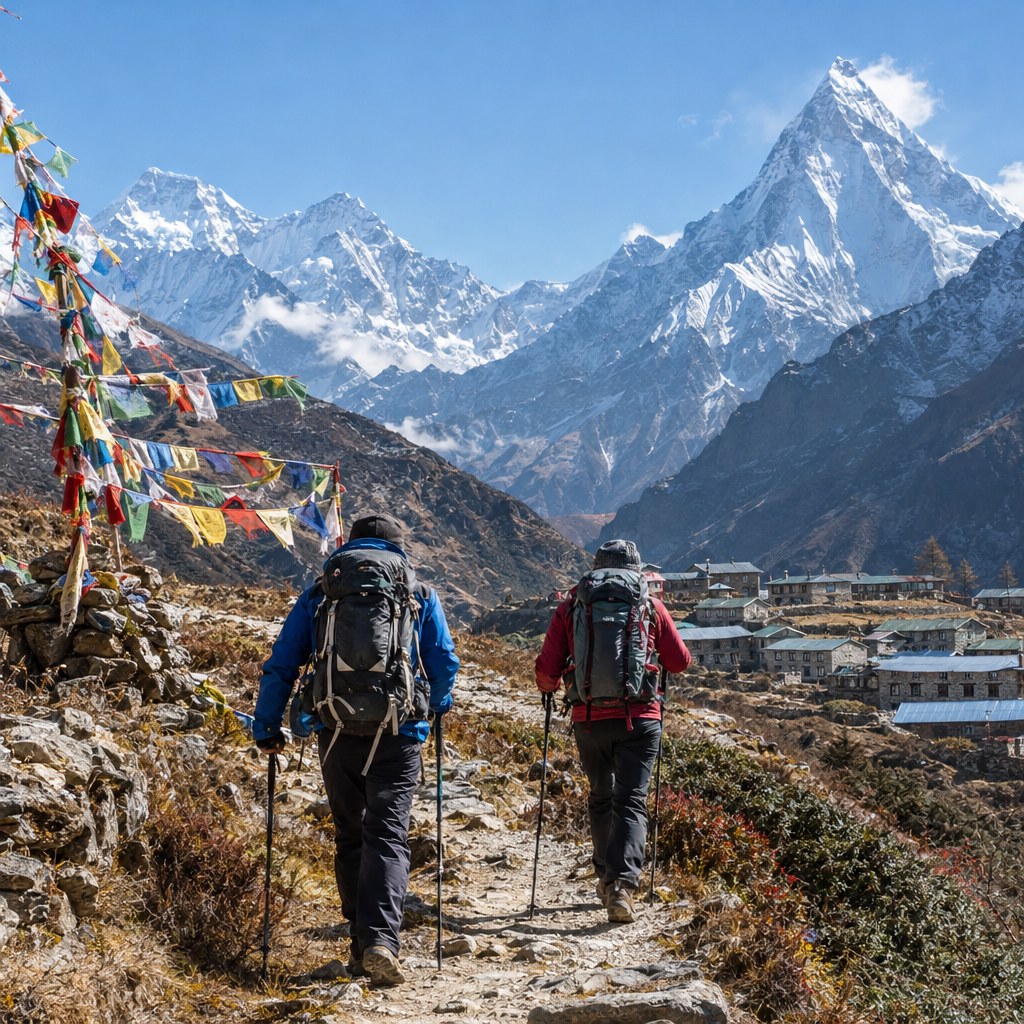
Nepal remains one of the world’s defining trekking destinations because the experience combines Himalayan landscapes with villages, monasteries, teahouses, and long-established trail culture.
The Nepal Tourism Board notes that many major treks travel between roughly 1,000 and 4,000 meters, with some popular routes rising above 5,000 meters. Its official trekking overview is a useful starting point for understanding the scale and variety of routes.
Which trekking regions stand out?
Everest, Annapurna, and Langtang remain the best-known regions, but the choice should depend on more than name recognition. Time available, altitude profile, desired comfort, cultural interest, and tolerance for crowds all matter.
Our guides to the Langtang Valley Trek and Everest versus Annapurna trekking offer additional context for comparing regions.
Why Experienced Travelers Often Choose Guided Trekking in Nepal
Experience does not eliminate the value of local guiding; in many cases, it makes travelers more aware of how much a strong guide contributes.
Route knowledge, acclimatization decisions, weather judgment, logistics, and access to local networks become increasingly important as altitude and remoteness increase.
Travelers considering a Nepal trekking tour should look closely at acclimatization days, guide-to-client ratios, porter support, contingency planning, and how the itinerary responds to weather or illness.
What permits should trekkers understand?
The Nepal Tourism Board explains that trekking requirements can include TIMS registration, protected-area entry fees, and special permits for restricted regions. Its official permits and fees guidance is worth checking before finalizing an itinerary.
For restricted areas, the Board also maintains a dedicated trekking permit page explaining when additional permission is required.

What Makes Nepal Trekking Feel Different?
Nepal’s defining quality is the way the human landscape and mountain landscape overlap.
A trekking day may include huge alpine views, suspension bridges, yak traffic, stone villages, teahouses, prayer flags, and long conversations over meals. The cultural dimension makes the journey feel richer than a purely wilderness-based trek.
How should experienced hikers prepare?
- Train for repeated climbing days rather than one big hike
- Practice carrying the pack weight you expect to use
- Build in acclimatization rather than trying to move faster
- Prepare for large temperature swings
- Understand that weather can change the itinerary
Even very fit travelers can struggle if they underestimate altitude. Fitness helps with the workload, but it does not replace acclimatization.
Patagonia: Big Landscapes and Fast-Changing Conditions
Patagonia offers a different kind of intensity: wind, distance, exposed terrain, glacier-fed lakes, and weather that can reshape a day quickly.
Chile’s official tourism site describes Patagonia as a region of fjords, forests, crystal-clear rivers, ice fields, and major adventure routes, and its Patagonia overview is useful for understanding how many different landscapes sit within the broader region.
Why Torres del Paine draws experienced hikers
Torres del Paine brings together granite towers, turquoise lakes, glaciers, steppe, and major trekking circuits in one compact national park.
Chile Travel’s official Torres del Paine guide highlights the W and O Circuits as the park’s defining multi-day trekking experiences.
For a deeper look at the region from our own site, see our Patagonia trekking guide and Carretera Austral guide.

When Does a Higher-End Patagonia Trip Make Sense?
In a remote region, higher-end travel can be valuable because it improves logistics, guiding, access, and recovery between demanding days.
Travelers comparing luxury tours to Patagonia should look beyond hotel quality and ask what the trip actually provides: expert guiding, private transfers, carefully chosen lodges, better access to trailheads, flexible routing, and support when weather disrupts the plan.
Why experience still matters
Comfort at night does not make a difficult trail easy. The Base Torres route, for example, is described by Chile Travel as a highly demanding hike with a steep final ascent, and its official Base Torres guide is useful for understanding why preparation matters.
That is exactly why experienced travelers often appreciate better logistics: it lets them spend more energy on the trail instead of on avoidable friction around the edges.
Nepal or Patagonia: Which Is the Better Adventure?
Nepal is the stronger choice if altitude, Himalayan culture, and multi-day trekking traditions are what excite you most. Patagonia is better if you want dramatic wilderness, lower-altitude trekking, glaciers, and a landscape shaped by wind and weather.
Choose Nepal if…
- You want a long high-altitude journey
- You value cultural immersion along the trail
- You are comfortable with teahouse-style trekking
- You want the Himalayas to be the central experience
Choose Patagonia if…
- You prefer lower altitude but still want demanding terrain
- You value wilderness, glaciers, and exposed landscapes
- You want strong lodge-based options
- You are comfortable planning around volatile weather

A well-chosen lodge can improve recovery and logistics without taking away from the physical challenge of a serious Patagonia trekking trip.
How Should Experienced Travelers Prepare for Either Destination?
Preparation should focus on durability rather than peak performance.
Train for repeated days, not one hard effort. Use the footwear and pack you expect to travel with. Build comfort on uneven terrain. Practice eating and drinking consistently while moving. And arrive with enough fitness margin that the first difficult day does not empty the tank.
What should you not over-optimize?
Do not build an itinerary that only works if every day goes perfectly. Both destinations reward flexibility.
Weather delays, slower acclimatization, transport changes, and trail conditions are part of serious adventure travel. A strong itinerary has room to absorb those changes without making the entire trip feel compromised.
What Makes These Trips Worth the Effort?
Nepal and Patagonia are memorable because the experience is earned gradually.
The strongest days are often not defined by one viewpoint. They are defined by the hours leading to it: the climb, the weather, the conversations, the fatigue, and the feeling of arriving somewhere that did not come easily.
That is what makes both destinations so well suited to experienced adventure travelers. They are not simply scenic. They ask something of you.

Frequently Asked Questions About Nepal and Patagonia Adventure Travel
- Q: Which is harder, trekking in Nepal or Patagonia? A: Nepal usually adds more altitude, while Patagonia often adds stronger wind, exposure, and rapidly changing weather.
- Q: Do experienced hikers still need guides? A: Guides can add significant value through logistics, local knowledge, safety judgment, and route adaptation.
- Q: What is the best trekking region in Nepal? A: Everest, Annapurna, and Langtang are all strong choices, but the best fit depends on time, altitude tolerance, desired comfort, and crowd levels.
- Q: Is Torres del Paine only for multi-day hikers? A: No. The park also has major day hikes, but its multi-day circuits are a defining experience for serious trekkers.
- Q: Does a luxury itinerary make the hiking easy? A: No. Higher-end planning can improve logistics and recovery, but the physical challenge remains real.
- Q: How far in advance should travelers plan? A: Major trekking seasons can book well ahead, especially when specific lodges, guides, or routes are important.
Nepal and Patagonia are two of the world’s great adventure destinations because neither one gives up its best experiences easily. For experienced travelers, that is exactly the point: the challenge, the landscape, and the logistics all become part of what makes the trip memorable.
+++BEFORE using this information, please read our Legal Disclaimer+++