
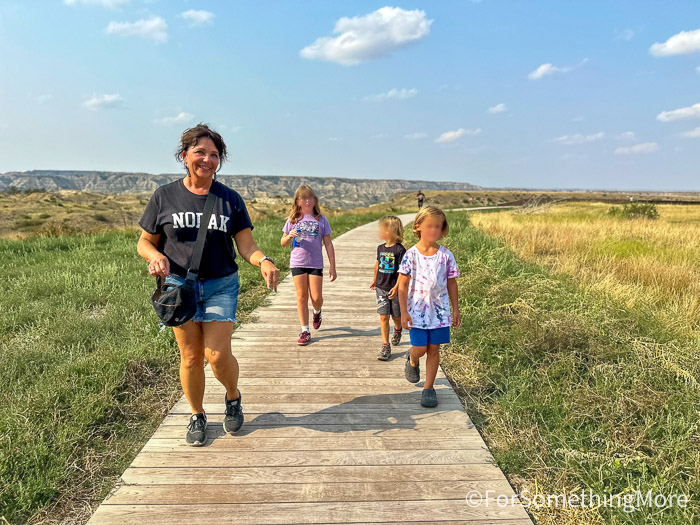
We recently visited the Theodore Roosevelt Presidential Library with a genuinely multigenerational group: our 5- and 7-year-old sons, our 11-year-old niece and nephew, our 17-year-old nephew, and a set of grandparents. That wide age range gave us a useful perspective on what visiting the Theodore Roosevelt Presidential Library with kids is actually like—and whether the experience works equally well for younger kids, preteens, teenagers, parents, and grandparents.
What stood out to us was how many different ways there were to engage. Our younger kids could focus on interactive technology, immersive environments, and hands-on elements, while the older kids and adults could dig further into Theodore Roosevelt’s life, presidency, conservation legacy, and connection to the North Dakota Badlands. You don’t need everyone in your family to experience the library at the same level or pace for the visit to work.
The main thing to anticipate is that a multigenerational group will naturally move through the library differently. Younger kids may race through information-heavy areas and then spend much longer than expected at an interactive exhibit, while teenagers and adults may want additional time with the historical material.
In this guide, we’ll share what we learned from visiting the Theodore Roosevelt Presidential Library with five kids ranging from 5 to 17 and grandparents, including which experiences worked particularly well for different ages, how to pace your visit, what to expect outside, and how to combine the library with Theodore Roosevelt National Park and a broader family adventure in Medora.
Table of Contents
Is the Theodore Roosevelt Presidential Library Worth Visiting With Kids?
Yes, the Theodore Roosevelt Presidential Library is absolutely worth visiting with kids, particularly for families who enjoy interactive learning, history, technology, nature, and experiences that extend beyond a traditional museum.
We recently visited the Theodore Roosevelt Presidential Library as a multigenerational family group, with our 5- and 7-year-old sons, our 11-year-old niece and nephew, our 17-year-old nephew, and a set of grandparents. That gave us a particularly useful perspective on the experience because our group included everyone from a kindergartener to grandparents.
What stood out to us was how well the library could accommodate that wide range of ages. The younger kids had plenty to interact with, while the older kids and adults could engage more deeply with the history and ideas behind the exhibits.
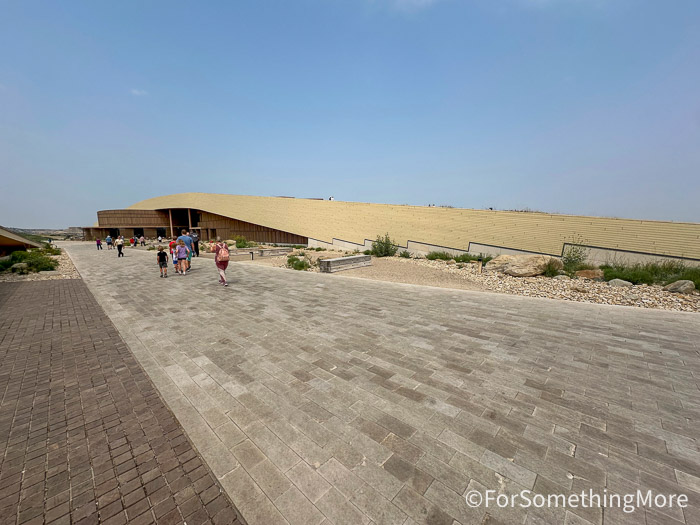
What Ages Is the Theodore Roosevelt Presidential Library Best For?
The Theodore Roosevelt Presidential Library can work well across a surprisingly broad range of ages, although different family members will naturally experience it differently.
Our five kids ranged from 5 to 17, and we did not need them to engage with every exhibit in the same way for the visit to work.
Younger kids are naturally more likely to gravitate toward:
- Interactive displays
- Large-scale visuals
- Multimedia
- Hands-on elements
- Exhibits that allow them to make choices or physically participate
Older kids and teenagers are better positioned to understand some of the historical context surrounding Roosevelt’s presidency, leadership, conservation, and legacy. Adults and grandparents can go deeper still, particularly in areas with more detailed historical information.
That makes this a particularly useful attraction for a multigenerational trip. Everyone can move through the same overall experience without necessarily needing to take the same thing away from it.
You also do not need to give your kids a Theodore Roosevelt history lesson before arriving. Some background knowledge can certainly add context, but the library provides enough orientation for visitors to understand who Roosevelt was and why his life and ideas matter.
With younger kids, expect to move more quickly through some information-heavy areas and considerably more slowly when they find something interactive. Trying to make everyone spend equal time at every exhibit is likely to make the visit harder rather than more meaningful.
What Makes This Presidential Library Different From a Traditional Museum?
The Theodore Roosevelt Presidential Library feels much more like an immersive learning experience than a conventional history museum.
That distinction was important for our family.
Instead of relying primarily on artifacts behind glass and long stretches of text, the library incorporates multimedia, interactive technology, large-scale environments, sound, and hands-on elements into the experience.
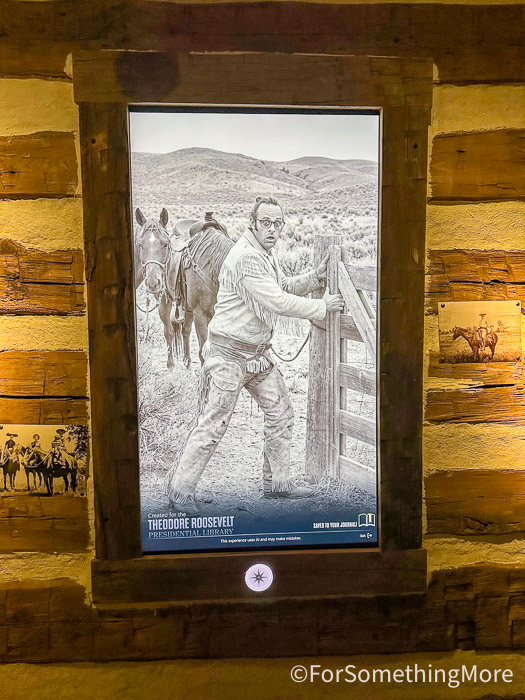
That variety helps when you’re traveling with several generations.
A younger child can be interested in what an exhibit allows them to see or do while a teenager, parent, or grandparent engages with the historical information behind it. You do not necessarily have to separate the group to find something appropriate for everyone.
It also means you should not estimate your visit based solely on how long your family normally spends in museums. Interactive exhibits can unexpectedly hold kids’ attention, while more text-heavy areas may move considerably faster.
The Theodore Roosevelt Presidential Library’s official website is the best source for current exhibits, programs, admission information, and operating hours before your visit.
Why Does the North Dakota Location Matter?
The library’s location in Medora is an important part of the experience because Theodore Roosevelt’s relationship with the North Dakota Badlands is central to understanding his life and conservation legacy.
For an outdoor family, this is one of the strongest reasons to include the Theodore Roosevelt Presidential Library in a Medora itinerary.
The Badlands are not simply a landscape being discussed inside the museum. They surround you.
After learning about Roosevelt’s experiences in this part of the country, you can step outside and begin connecting that history to an actual place.
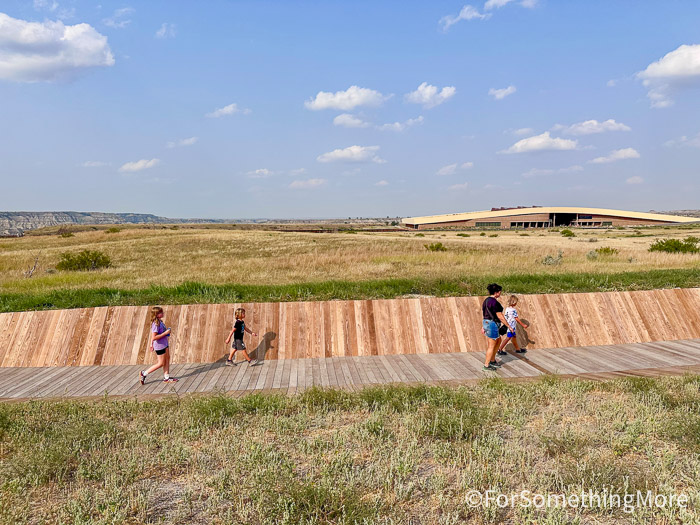
That connection becomes even stronger if you combine the library with Theodore Roosevelt National Park. Kids can learn why the landscape mattered to Roosevelt and then spend time hiking, watching wildlife, and exploring the broader Badlands environment themselves.
For our family, that indoor-outdoor connection was one of the things that made the library feel particularly appropriate for the way we like to travel.
Is It Worth Visiting If Your Kids Aren’t Really Into History?
Yes, kids do not need to consider themselves history enthusiasts to enjoy the Theodore Roosevelt Presidential Library.
This was important with such a broad age range in our group. We were not bringing five Theodore Roosevelt experts through the doors, nor did we need to.
If your kids enjoy interactive museums, technology, animals, nature, outdoor spaces, or learning by doing, there are multiple ways for them to engage beyond simply reading about presidential history.
The deeper historical material is still there for teenagers and adults who want it.
That balance is one of the library’s strengths for families: your 5-year-old does not need to understand an exhibit at the same level as your 17-year-old for both of them to get something worthwhile from the experience.
Is the Theodore Roosevelt Presidential Library Good for a Multigenerational Family Trip?
Yes, based on our experience, the Theodore Roosevelt Presidential Library is particularly well suited to a multigenerational family outing.
Our group included five kids between 5 and 17 as well as parents and grandparents, and the library gave different generations different ways to engage with the same subject.
That doesn’t mean everyone will want to spend exactly the same amount of time everywhere.
Younger children may be ready to move while adults are still reading. A teenager may become interested in historical context that means very little to a 5-year-old. Grandparents may want more time with particular exhibits than the kids do.
Those differences are normal.
The practical solution is to allow some flexibility within the group rather than expecting everyone to experience the library identically.
Planning Takeaway
The Theodore Roosevelt Presidential Library is a strong choice for families with children across a wide range of ages, and our multigenerational visit reinforced that there is no single age at which kids suddenly become “old enough” for the experience.
Our five kids ranged from 5 to 17, and having grandparents with us widened that range considerably. The interactive and visual elements give younger kids accessible ways into the experience, while older kids and adults can engage more deeply with Roosevelt’s history, presidency, conservation ideas, and legacy.
If you’re visiting the Theodore Roosevelt Presidential Library with kids, don’t worry about making everyone experience it in exactly the same way. Give younger children room to follow what catches their attention, allow older family members to dig deeper where they want to, and make time for the outdoor landscape that connects the entire experience back to Medora and the North Dakota Badlands.
What Is It Actually Like Inside the Theodore Roosevelt Presidential Library?
The Theodore Roosevelt Presidential Library feels more like an immersive, interactive experience than a traditional presidential museum, using technology, multimedia, historical material, and recreated environments to explore Roosevelt’s life, presidency, ideas, and connection to the American West.
Our multigenerational group gave us an interesting perspective on how that approach works. We visited with five kids ranging from 5 to 17, along with a set of grandparents, and there was enough variety that different generations could engage with the same spaces at different levels.
For our younger kids, the interactive and visual elements were especially important. The older kids, adults, and grandparents could spend more time with the historical context without the entire experience depending on everyone wanting to stop and read the same information.
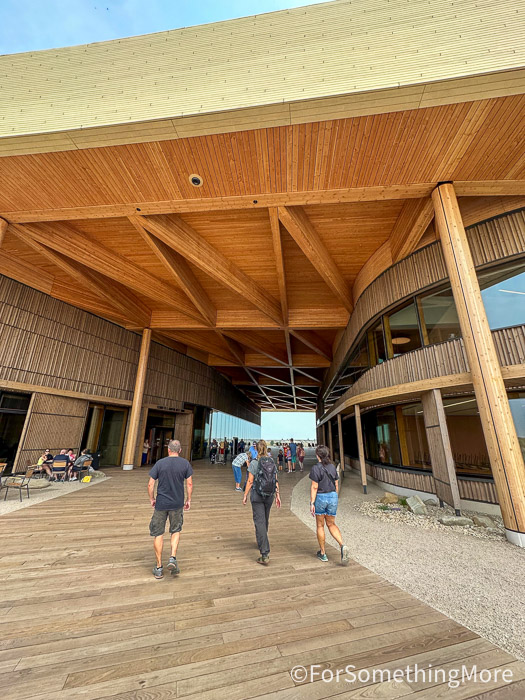
How Does the Theodore Roosevelt Presidential Library Tell Roosevelt’s Story?
The library tells Theodore Roosevelt’s story through a combination of historical information, artifacts, interactive technology, multimedia, and immersive environments rather than relying on a simple chronological collection of objects.
As you move through the library, different parts of Roosevelt’s life and the issues that shaped him begin to connect. The exhibits provide enough background that you don’t need to arrive with extensive knowledge of Roosevelt to understand the broader story.
That was useful with the age range in our group.
Our 5-year-old obviously wasn’t going to process the historical material in the same way as our 17-year-old nephew or the grandparents. He didn’t need to. The visual and interactive elements gave the younger kids ways to participate while older members of our group could absorb more of the historical context.
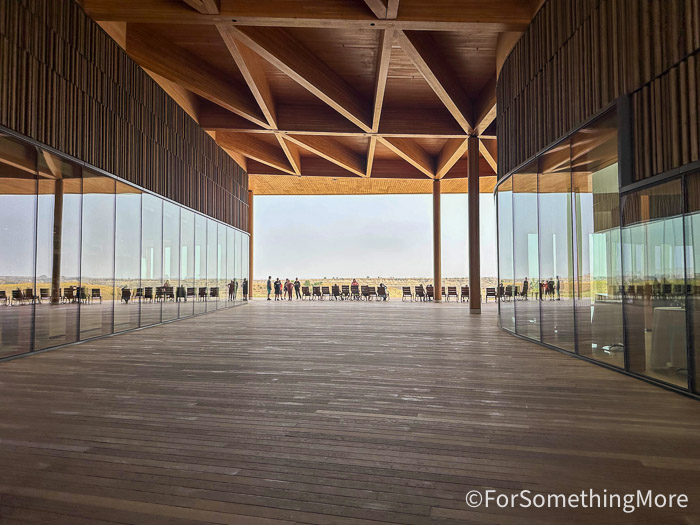
For a multigenerational family, that means you can largely experience the library together rather than needing completely different activities for different ages.
How Interactive Are the Exhibits?
The Theodore Roosevelt Presidential Library is highly interactive, and those participatory elements were some of the most useful features for keeping our younger kids engaged.
Several exhibits ask you to do something rather than simply observe. That change in format regularly gave the kids a new reason to stop and pay attention.
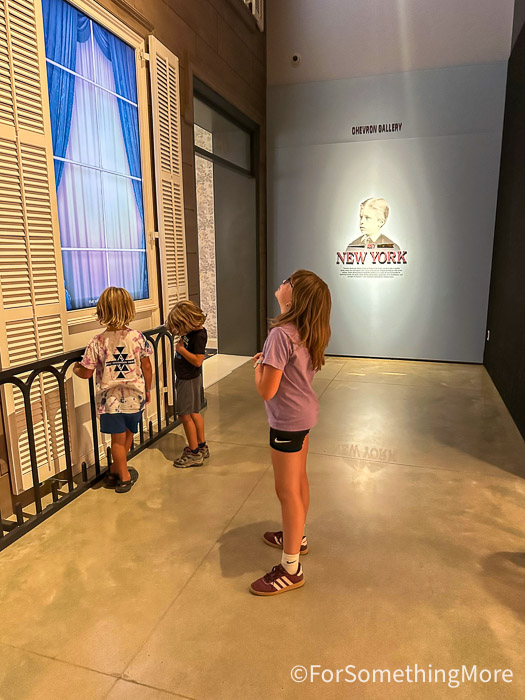
Interactive exhibits also create a less predictable pace.
A child might move past several displays fairly quickly and then spend considerably longer than expected with one interactive element. With five kids in our group, we couldn’t assume that everyone would be ready to move on simultaneously.
We found it more practical to allow some flexibility rather than trying to maintain a uniform pace.
With younger kids, expect screens, physical controls, choices, and other interactive elements to take longer than nearby text panels. If you’re estimating how long your family will spend inside, leave room for those unexpected stops.
What Are the Immersive Multimedia Experiences Like?
Large-scale multimedia and environmental experiences are an important part of the Theodore Roosevelt Presidential Library and help break up sections requiring more reading and historical concentration.
Instead of presenting Roosevelt’s entire story through text and artifacts, some spaces use imagery, sound, projections, and the surrounding environment to communicate a place, event, or idea.
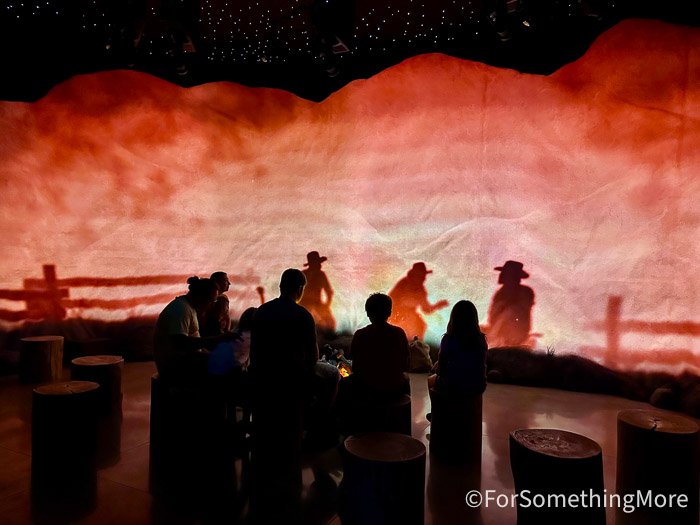
These experiences are particularly useful when you’re visiting with a broad age range.
A younger child can respond to what is happening visually and physically around them without understanding every historical detail. Older kids and adults can connect those same elements to the larger historical story.
That layered approach worked well for our group because our five kids ranged from early elementary age through the late teenage years.
Even so, not every immersive experience will hold every child’s attention equally. Some still require visitors to stop, listen, and follow what is happening. With younger kids, it is usually more productive to move along once they have clearly disengaged rather than insist that they absorb every part of the presentation.
How Does the Library Connect Roosevelt to the American West?
The library makes Roosevelt’s experiences in the Dakota Badlands an important part of understanding his development, ideas, and later conservation legacy.
This was one of the parts that made the Theodore Roosevelt Presidential Library especially relevant to us as an outdoor family.
The western setting isn’t presented as an unrelated chapter from Roosevelt’s past. His experiences with ranching, hunting, wildlife, loss, and the Badlands help establish why this landscape became so important to his story.
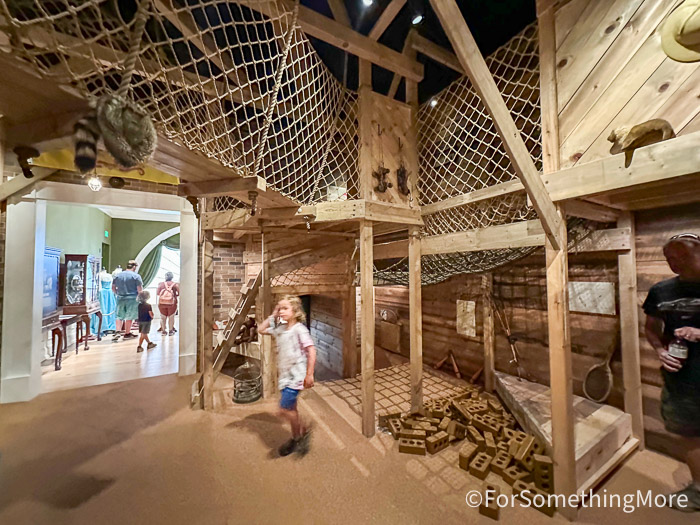
For kids, there is a major advantage to learning this material in Medora.
When you eventually walk outside, the landscape you’ve been hearing about is around you. If you also visit Theodore Roosevelt National Park, that connection becomes even more concrete.
The National Park Service provides additional historical context about Theodore Roosevelt’s time in the Dakota Territory and the influence those experiences had on his life.
Does the Library Explore Roosevelt’s Presidency and Complicated Legacy?
Yes, the Theodore Roosevelt Presidential Library goes beyond Roosevelt’s image as an outdoorsman and presents his presidency, political decisions, leadership, and broader legacy as important parts of his story.
These portions naturally work differently across generations.
Our older kids, adults, and grandparents were capable of engaging with historical and political material at a level that wouldn’t be realistic to expect from a 5- or 7-year-old.
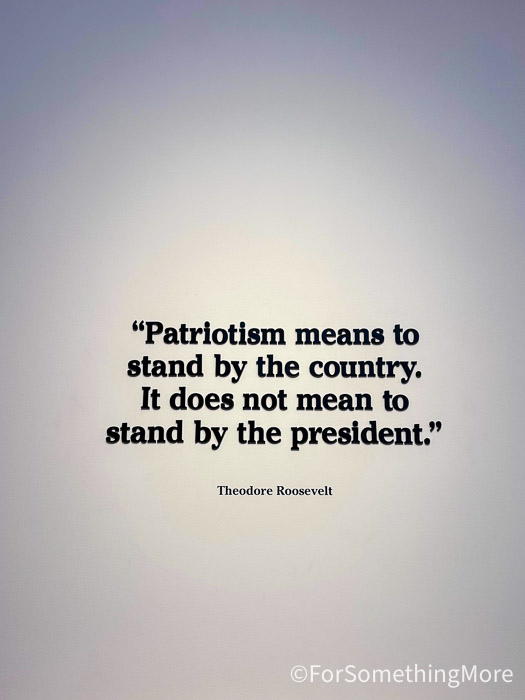
That doesn’t make those areas unsuitable for families with young children. It simply means you should adjust your expectations.
Younger kids can focus on the visual or interactive components while older members of the family spend more time with the information. With a multigenerational group, allowing slightly different pacing can make these sections considerably easier.
Does the Library Feel Like Too Much for Younger Kids?
The Theodore Roosevelt Presidential Library contains a substantial amount of information, but its varied presentation makes the experience manageable for younger kids when you don’t expect them to engage deeply with everything.
This is one of the clearest lessons from our visit.
We had children at 5, 7, 11, 11, and 17. Expecting all five of them to process every gallery at the same level would have made little sense.
A more realistic approach is to:
- Stop longer when your kids are genuinely engaged.
- Move more quickly through areas that aren’t holding younger children’s attention.
- Give older kids opportunities to explore subjects more deeply.
- Allow adults and grandparents additional reading time where practical.
- Use interactive and immersive exhibits as natural changes of pace.
- Accept that different family members may remember completely different parts of the experience.
Museum fatigue still matters, even in a highly interactive museum. Younger kids in particular can go from engaged to finished fairly quickly, so paying attention to their energy is more useful than trying to complete every exhibit.
Planning Takeaway
Expect the Theodore Roosevelt Presidential Library to feel like a series of different experiences rather than one continuous traditional museum visit.
Visiting with five kids ranging from 5 to 17, along with grandparents, showed us how useful that variety can be for a multigenerational family. Younger children can connect through interactive technology, visuals, and immersive environments, while teenagers and adults have considerably more historical depth available when they want it.
You don’t need everyone in your family to experience the library identically. Follow the younger kids’ interest when something catches their attention, give older family members opportunities to dig deeper, and accept that your group may move through different parts of the library at very different speeds.
What Are the Best Theodore Roosevelt Presidential Library Experiences for Kids?
The best Theodore Roosevelt Presidential Library experiences for kids are the interactive and immersive exhibits that let them participate, make choices, watch, listen, and engage rather than simply read about history.
Visiting with five kids ranging from 5 to 17 gave us a good opportunity to see how differently children can approach the same museum. Our younger kids were naturally drawn toward experiences that gave them something to do, while the older kids could engage more deeply with the information and ideas behind those experiences.
You don’t need every child to find the same exhibit equally interesting. For us, allowing the kids to spend more time with what genuinely caught their attention worked much better than trying to move everyone through the library at exactly the same pace.
Which Interactive Exhibits Are Best for Kids?
The strongest interactive exhibits are the ones that turn historical information and ideas into something kids can actively explore.
For our 5- and 7-year-olds in particular, having something to touch, control, choose, or respond to helped break the museum into manageable pieces. They weren’t being asked to spend the entire visit absorbing information passively.
Our 11-year-old niece and nephew and 17-year-old nephew could approach those same experiences differently. They were old enough to understand more of the historical context surrounding an activity rather than focusing primarily on the interaction itself.
That ability to engage at multiple levels is particularly helpful for families with a wide age range.
With several kids, however, expect interactive exhibits to slow you down. One child may finish almost immediately while another wants another turn or spends considerably longer exploring what the exhibit can do.
Which Immersive Experiences Should Families Make Time For?
The large-scale immersive experiences are worth slowing down for because they give kids another way to understand history without depending entirely on reading.
Some spaces use imagery, sound, projections, or environmental elements to surround visitors with the subject being presented.
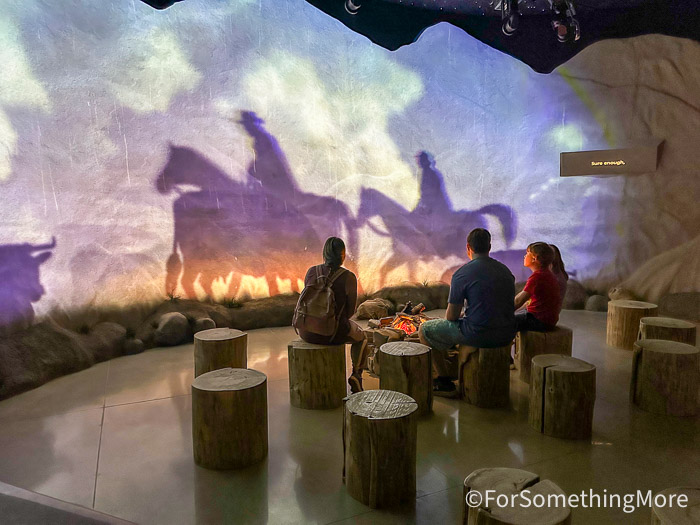
These experiences worked well with the broad age range in our group because they didn’t require everyone to engage in exactly the same way.
Our younger kids could respond to what they were seeing and hearing. The older kids, parents, and grandparents could connect the presentation to more of the historical information surrounding it.
With younger children, give an immersive experience a moment to develop before deciding they’re uninterested. Some require kids to stop moving and settle into what is happening.
At the same time, if a young child has clearly checked out, forcing them to stay through an entire presentation rarely improves the experience.
What Experiences Help Kids Understand Roosevelt’s Connection to Nature?
The exhibits connecting Theodore Roosevelt to wildlife, the outdoors, the Dakota Badlands, and conservation are particularly useful for families who plan to explore outside during their Medora trip.
This was one of the strongest connections for us as an outdoor family.
Inside, the kids could begin understanding why Roosevelt’s experiences in this part of the country mattered. Outside, they could see the type of landscape being discussed rather than treating the Badlands as an abstract historical setting.
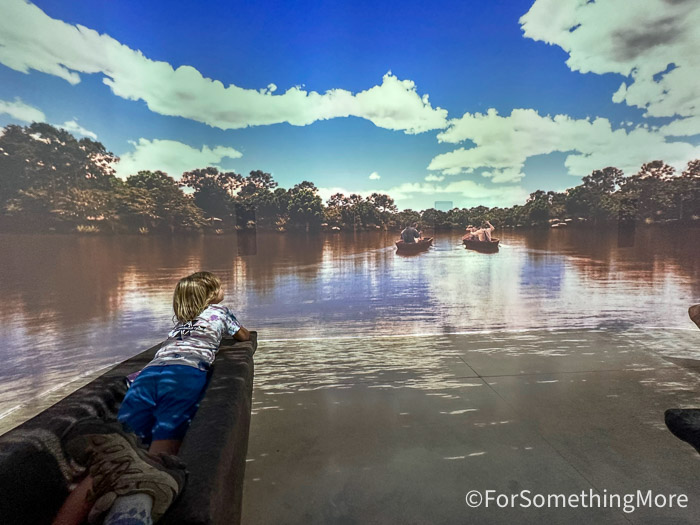
You don’t need to turn these exhibits into a formal lesson for younger kids.
Simply establishing that Roosevelt spent significant time in this landscape and that those experiences influenced him gives children useful context for exploring the area afterward.
If you’re also visiting Theodore Roosevelt National Park, that connection becomes even stronger.
The National Park Service provides additional context about Theodore Roosevelt’s experiences in the Dakota Territory and his relationship with the landscape.
Are the Technology-Based Exhibits Good for Different Ages?
Yes, the technology-based exhibits can work across a wide age range because younger kids can participate directly while older children and adults can engage more deeply with what the interaction represents.
That distinction became clearer with five kids between 5 and 17 in our group.
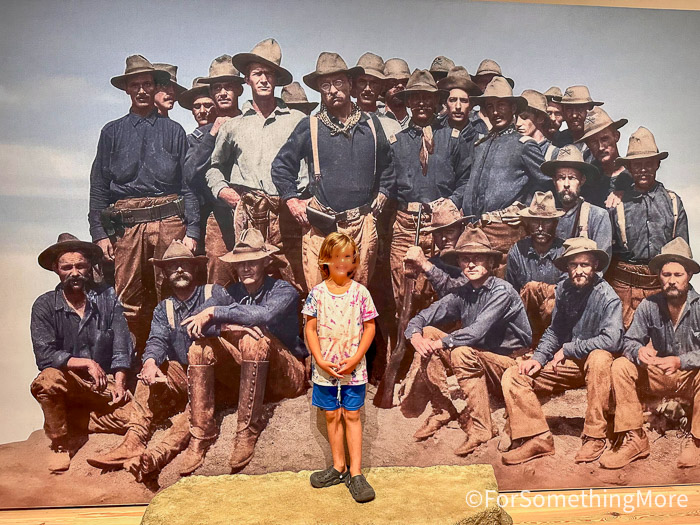
Our younger kids didn’t need to understand every layer of historical context for an interactive experience to hold their attention. The older kids were capable of making more connections between what they were doing and the information surrounding it.
For parents, that makes these exhibits useful gathering points for a multigenerational group. Different family members can interact with the same material without needing it simplified to a single age level.
Technology alone doesn’t automatically make an exhibit engaging, of course. What matters is whether the interaction helps visitors understand or think about the subject rather than simply giving them another screen to use.
Which Parts Might Younger Kids Move Through More Quickly?
Younger children will probably move more quickly through areas that depend heavily on reading, listening, or understanding complicated historical and political context.
That was completely manageable for our family because we expected different ages to engage differently.
Our 17-year-old nephew could reasonably spend more time with detailed historical material than our 5-year-old son. The grandparents could also choose to slow down and read information that the younger kids were ready to move past.
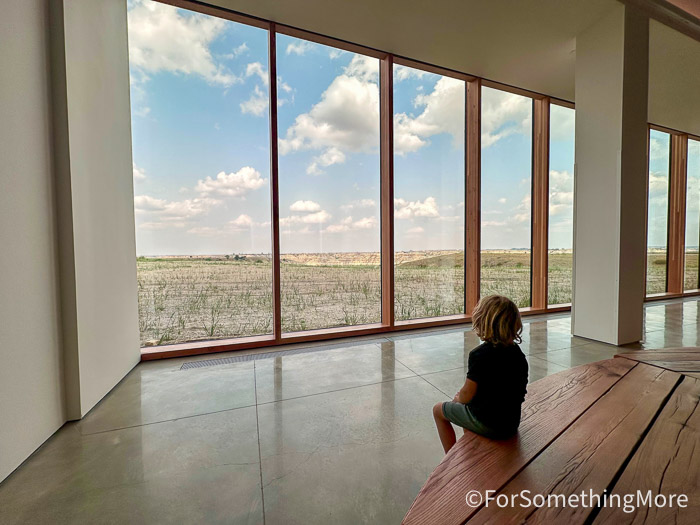
This is where a multigenerational group may need a little flexibility.
You don’t necessarily need to keep everyone shoulder-to-shoulder through every exhibit. Where the environment allows it, younger kids can focus on something visual or interactive nearby while older family members take additional time with the detailed material.
Most importantly, don’t interpret a younger child moving quickly through one section as evidence that the library isn’t working for them. Their attention may return immediately when the format changes.
Should You Let Kids Set the Pace?
Kids should influence the pace of your visit, although that doesn’t mean letting them race through the Theodore Roosevelt Presidential Library unchecked.
For us, the useful distinction was between rushing and following genuine interest.
When one of the kids found something engaging, we could slow down. When the younger kids had clearly finished with an area, there was little benefit in making them remain simply because an adult could have spent another ten minutes reading.
A practical approach is to:
- Slow down when an interactive exhibit catches their attention.
- Move on when everyone has clearly finished with a section.
- Give younger kids help when an interaction isn’t immediately intuitive.
- Allow older kids and adults to read more deeply where practical.
- Accept that five children may not be ready to move on simultaneously.
- Pay attention to energy before museum fatigue becomes the dominant part of the visit.
With younger kids, attention tends to come in waves. Alternating information-heavy sections with interactive and immersive experiences made a longer museum visit much easier for our group.
Is the Library Engaging for Teenagers Too?
Yes, teenagers can get considerably more from the Theodore Roosevelt Presidential Library than the younger-child-focused parts of this guide might initially suggest.
Having our 17-year-old nephew with us was useful because it extended our firsthand experience well beyond the elementary-age range.
A teenager can still participate in interactive exhibits, but they are also much better positioned to engage with the historical questions, political context, conservation issues, leadership decisions, and complexities of Roosevelt’s legacy.
That makes the library easier to recommend for families whose children have substantial age gaps.
You aren’t choosing an attraction designed primarily for little kids and hoping the teenager tolerates it. Nor are you choosing an adult history museum and hoping the younger kids make it through.
There is enough range for different ages to approach the experience differently.
Planning Takeaway
Don’t try to make your children experience the Theodore Roosevelt Presidential Library exactly the same way.
Our five kids ranged from 5 to 17, and that age spread actually highlighted one of the library’s strengths. The younger kids had interactive, visual, and immersive ways to engage, while the older kids could understand more of the history and ideas behind what they were experiencing.
Follow genuine interest, allow different family members to spend different amounts of time with exhibits when practical, and don’t worry if your 5-year-old and 17-year-old walk away remembering completely different things. For a family attraction, that’s not necessarily a weakness—it is part of what allows the Theodore Roosevelt Presidential Library to work across such a broad age range.
How Much Time Should Families Allow at the Theodore Roosevelt Presidential Library?
Families should plan several hours for the Theodore Roosevelt Presidential Library and leave additional time for the outdoor grounds rather than treating it as a quick museum stop.
Visiting as a multigenerational group with five kids ranging from 5 to 17, plus grandparents, reinforced how difficult it is to assign one exact amount of time to the experience. Different ages naturally move through the exhibits at different speeds.
Our younger kids could move quickly through some information-heavy areas and then spend considerably longer when they found something interactive. Meanwhile, the older kids and adults had more reason to slow down for detailed historical material.
How Long Should You Spend Inside the Theodore Roosevelt Presidential Library?
Families should allow enough time inside the library to follow genuine interest rather than trying to maintain a predetermined pace through every gallery.
The Theodore Roosevelt Presidential Library combines interactive exhibits, immersive environments, multimedia presentations, artifacts, and more detailed historical material. Each type of exhibit creates a different pace.
That was especially noticeable with our group.
Our 5- and 7-year-olds naturally moved differently through the museum than our two 11-year-olds and 17-year-old. The adults and grandparents had their own interests and reasons to linger as well.
As a general planning approach, expect:
- Interactive exhibits to take longer than they initially appear.
- Younger kids to move faster through reading-heavy sections.
- Older kids and adults to spend more time with historical context.
- Multimedia experiences to temporarily bring everyone back to a similar pace.
- Different family members to be ready to move on at different times.
- Your overall pace to become less predictable when someone finds an exhibit they genuinely enjoy.
Trying to calculate exactly how many minutes you’ll spend in each area isn’t particularly useful. Give yourself enough flexibility that an unexpectedly engaging exhibit doesn’t become a scheduling problem.
Should You Try to See Every Exhibit?
Families should focus on experiencing the library well rather than making every person engage deeply with every exhibit.
With our age range, expecting everyone to experience the museum identically would have been unrealistic.
A 5-year-old, an 11-year-old, a 17-year-old, and a grandparent may all find value in the same gallery for completely different reasons. They also won’t necessarily want to remain there for the same amount of time.
We found it much more practical to let those differences influence our pace.
If a younger child is absorbed in an interactive experience, there is little reason to rush simply because another gallery is waiting. Conversely, if younger kids have clearly lost interest in an information-heavy section, forcing them to remain longer rarely improves what they take away from it.
With younger children, museum fatigue can appear quickly once they stop having something active to do. Pay attention to that change rather than waiting until everyone is completely finished with the experience.
Should You Leave Time for the Outdoor Grounds?
Yes, families should deliberately leave time for the outdoor grounds because they are an important part of experiencing the Theodore Roosevelt Presidential Library in its Badlands setting.
This is particularly valuable after spending a substantial amount of time indoors.
For the younger members of our group, heading outside provided an opportunity to move more freely after the concentration required inside. For everyone else, it provided another way to understand why the library’s location in Medora matters.
The outdoor experience reinforces something you’ve been learning about inside: Roosevelt’s relationship with North Dakota was closely connected to the landscape itself.
We would not recommend reaching the end of the indoor exhibits and immediately heading for the car simply because you consider the “museum” portion finished.
We’ll cover the grounds and what families can do outside in much more detail in the next section.
Should You Visit the Library and Theodore Roosevelt National Park on the Same Day?
You can visit the Theodore Roosevelt Presidential Library and Theodore Roosevelt National Park on the same day, but families should avoid treating either one as a rushed half-day attraction.
Pairing the two makes a lot of sense. The library provides context for Roosevelt’s connection to the Badlands, while the national park gives your family an opportunity to experience that landscape directly.
The challenge is energy rather than distance.
Even an interactive museum requires concentration, especially for younger children. Several hours inside followed by the library grounds and then hiking or exploring in Theodore Roosevelt National Park can already make for a substantial family day.
This is where having kids ranging from 5 to 17 mattered for us. What feels like a manageable afternoon to a teenager or adult may be a much bigger ask for a 5-year-old who has already spent several hours actively engaged inside.
The National Park Service publishes current road conditions, closures, alerts, and other important visitor information for Theodore Roosevelt National Park, so check current conditions before building the park into the same day’s plans.
Does a Multigenerational Group Need More Time?
A multigenerational family should build some extra flexibility into the visit because a wider range of ages usually means a wider range of interests and pacing.
That does not necessarily mean your visit will take dramatically longer.
It means you should avoid creating a schedule that only works if everyone moves through the library at exactly the same speed.
Our group included young children, preteens, a teenager, adults, and grandparents. At various points, some people were ready to move while others still had something they wanted to see.
Allowing a little flexibility made that much easier.
If you’re traveling with grandparents or anyone with mobility considerations, pacing may also be influenced by comfort and energy rather than simply interest. Build enough margin into the day that taking a break or moving more slowly doesn’t immediately put the rest of your plans behind schedule.
How Should Families Think About Timing?
The best approach is to treat your Theodore Roosevelt Presidential Library visit as a flexible block of the day rather than an attraction with a rigid departure time.
A practical structure is:
- Allow a substantial block for the indoor library experience.
- Expect younger and older family members to move at different speeds.
- Leave additional time for the outdoor grounds.
- Include a genuine break for food and downtime.
- Keep later Medora activities flexible when possible.
- Avoid putting a tightly timed commitment immediately after your expected departure.
If your family moves through the library faster than expected, extra time in Medora is easy to use.
If your kids become absorbed in the exhibits—or the grandparents want additional time with something that interests them—you’ll be glad you aren’t constantly watching the clock.
Planning Takeaway
Don’t approach the Theodore Roosevelt Presidential Library as something your family needs to complete within a rigid amount of time.
Visiting with five kids ranging from 5 to 17, along with grandparents, showed us just how differently people can move through the same experience. Younger kids may linger at interactive exhibits, while teenagers, adults, and grandparents may want additional time with historical material.
Plan several hours, leave time for the outdoor grounds, and keep whatever comes afterward reasonably flexible. For a multigenerational family in particular, having enough time for everyone to engage at their own level is much more useful than trying to keep the entire group moving at exactly the same pace.
What Can Families Do Outside the Theodore Roosevelt Presidential Library?
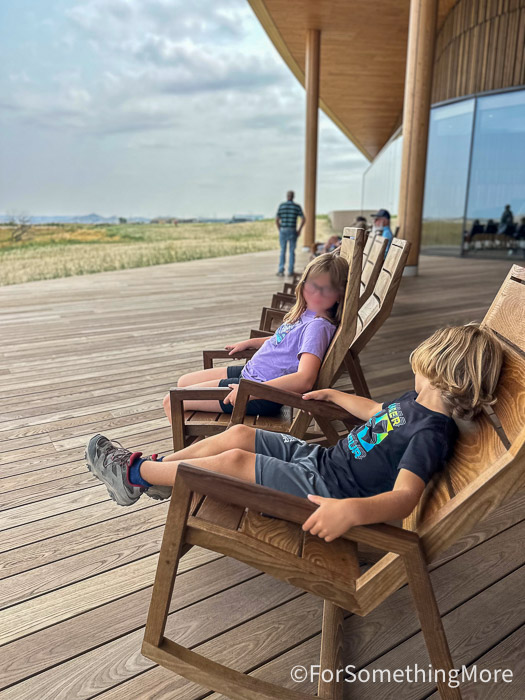
Families should leave time to explore the outdoor grounds of the Theodore Roosevelt Presidential Library, where walking paths, play-oriented features, native landscaping, and views across the Badlands make the outside experience a meaningful extension of the exhibits indoors.
For our multigenerational group, heading outside also created a useful change of pace. After spending time reading, listening, watching, and interacting indoors, the younger kids could move more freely while the rest of us could experience the landscape that gives the library much of its geographical context.
That indoor-outdoor combination was one of the things that made the Theodore Roosevelt Presidential Library particularly appealing to us as an outdoor family.
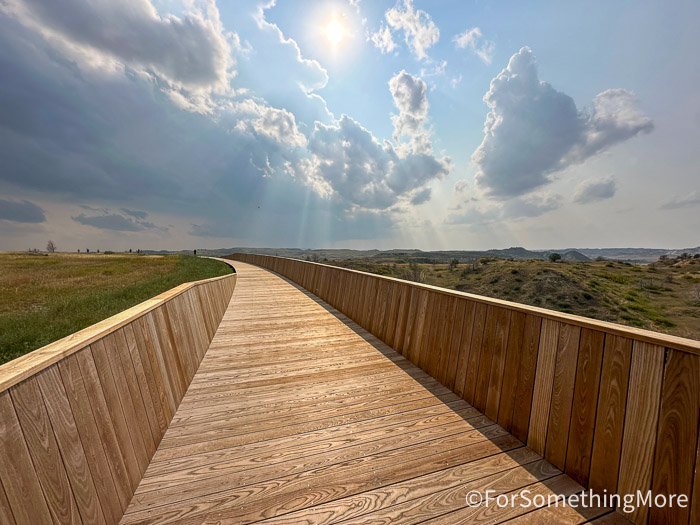
Are the Theodore Roosevelt Presidential Library Grounds Worth Exploring?
Yes, the outdoor grounds are worth making part of your visit rather than treating them simply as landscaping around the library.
The setting is an important part of understanding why the Theodore Roosevelt Presidential Library is in Medora in the first place.
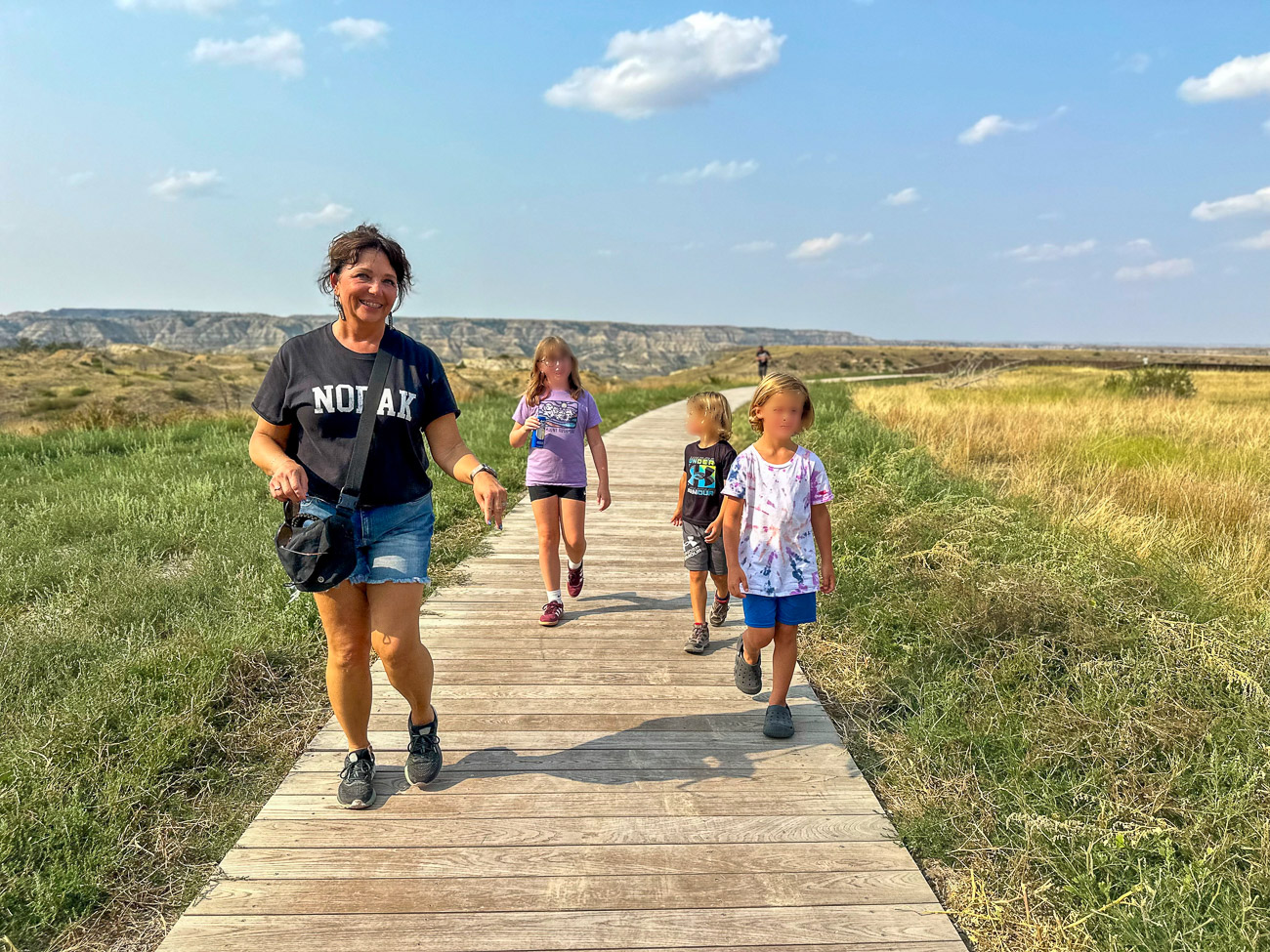
Paths and boardwalks take you away from the building and into the surrounding landscape, giving the experience a distinctly different feel from spending another hour inside a museum.
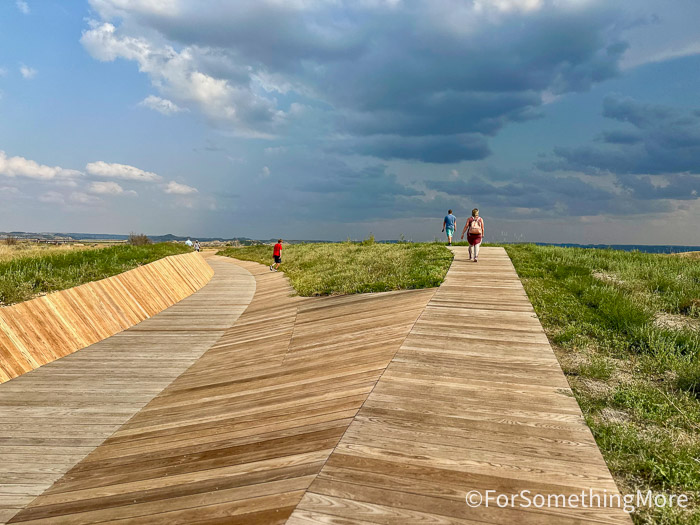
That change worked particularly well for our group because we had such a wide range of ages. The younger kids could move and explore, while the older members of the family could slow down and take in the landscape without everyone needing to participate in another structured activity.
You also get a better sense of the relationship between the architecture and the land once you move farther from the building.
For an outdoor family travel itinerary, we would consider the grounds part of the Theodore Roosevelt Presidential Library experience rather than something separate from it.
Are There Things for Kids to Do Outside?
Yes, the grounds give kids opportunities for physical movement and exploration rather than limiting the outdoor portion to walking and looking at scenery.
This was particularly valuable for our 5- and 7-year-olds.
Even an interactive museum requires kids to regulate their movement for a long period. Going outside changes those expectations and gives younger children a chance to use some physical energy.
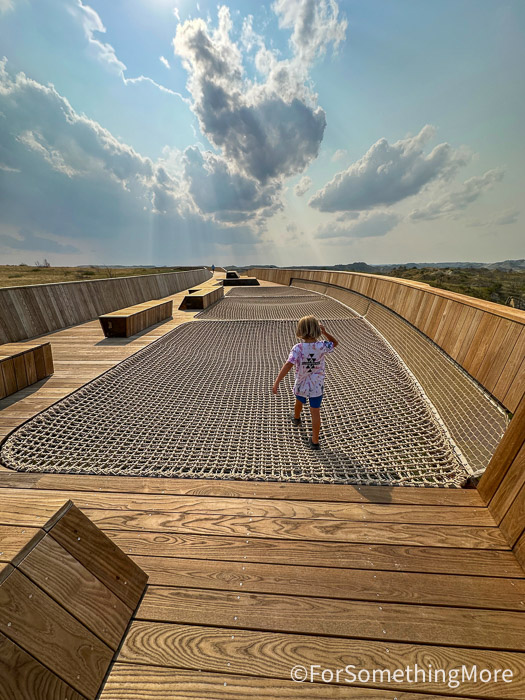
That doesn’t mean the outdoor grounds should be approached like a conventional playground. Parents still need to supervise younger children and decide what is appropriate based on their abilities and the conditions.
But from a family-planning perspective, having an active outdoor component makes a substantial indoor museum experience considerably easier to incorporate into a full day.
For families with children spanning several ages, the outdoor portion also requires less coordination. Our 17-year-old nephew obviously did not need the same kind of physical outlet as our 5-year-old, but everyone could still experience the grounds together.
How Does Being Outside Add to the Library Experience?
Being outside gives families a physical reference point for the Badlands landscape that played such an important role in Theodore Roosevelt’s life.
Inside the library, you encounter Roosevelt’s experiences in the Dakota Territory and the influence those years had on him. Outside, the landscape gives those ideas geographical context.
For kids, that distinction matters.
“The Badlands influenced Theodore Roosevelt” is an abstract historical idea. Standing outside in Medora and seeing the terrain makes it much easier to understand what kind of environment the exhibits are describing.
This was useful across the age range in our group. Our younger kids did not need to understand the deeper historical implications to recognize the connection between what they had seen inside and what was surrounding them outside. The older kids and adults could make more of those connections for themselves.
The National Park Service provides additional historical context about Theodore Roosevelt’s time in the Dakota Territory and how his experiences in this landscape influenced his later life and conservation philosophy.
What Is It Like Walking the Grounds With a Multigenerational Family?
The outdoor grounds work well for a multigenerational group because exploring them can be considerably less structured than moving through the indoor exhibits.
You don’t necessarily need to turn the outdoor portion into another educational activity.
Let the kids move. Stop when someone wants to look at something. Give grandparents and other family members time to enjoy the setting at their own pace.
For us, that change in rhythm was useful.
Families sometimes underestimate how much mental energy children use inside an immersive museum. Even when kids are enjoying themselves, they are constantly processing sounds, screens, instructions, information, and unfamiliar environments.
Going outside removes much of that stimulation at once.
With a multigenerational group, however, remember that everyone’s comfortable walking pace may be different. There is little reason to rush through the grounds simply to keep the entire group moving together.
How Much Time Should Families Spend Outside?
Families should leave enough time to explore the grounds without needing to rush, but the outdoor portion can remain one of the most flexible parts of the visit.
You do not need to decide in advance that your family will spend a specific number of minutes outside.
If the younger kids are energized by being outdoors and everyone is comfortable, stay longer. If the grandparents or other family members are ready for a break, or if the weather isn’t cooperating, shorten the experience.
That flexibility is particularly useful if you’re planning to visit Theodore Roosevelt National Park later in the day.
The library grounds can act as a transition between several hours indoors and a larger outdoor adventure rather than another item that needs to be completed on schedule.
What Is the Weather Like on the Library Grounds?
Families should prepare for the grounds as an exposed western North Dakota environment rather than assuming that clothing comfortable inside the library will automatically be comfortable outside.
Sun, wind, heat, cold, and changing weather can all affect how long your family wants to remain outdoors.
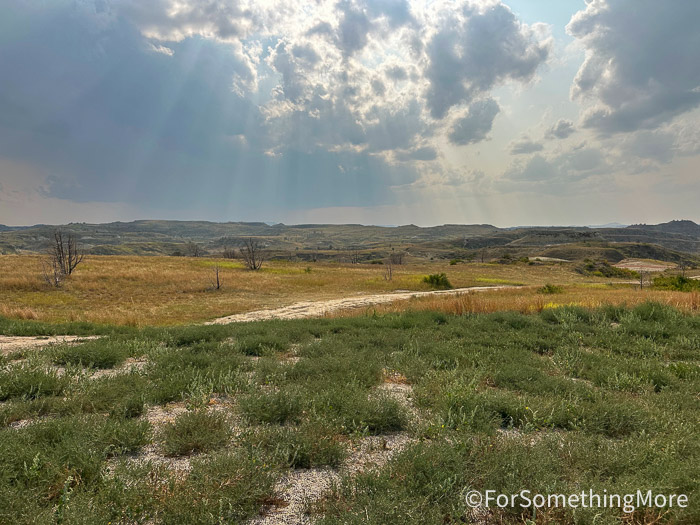
This matters even more in a multigenerational group because comfortable conditions for one person may not be comfortable for everyone.
Bring appropriate layers, use sun protection when conditions warrant it, and pay attention to the forecast.
If uncomfortable or hazardous weather develops, don’t force the outdoor portion simply because it was part of your original plan. You can adjust how much time you spend outside according to the conditions you actually encounter.
Planning Takeaway
Don’t finish the indoor exhibits and automatically head for the parking lot.
For our multigenerational family, the outdoor grounds helped make the Theodore Roosevelt Presidential Library feel like a natural part of an outdoor trip to Medora rather than simply an indoor history attraction. Our younger kids could move after spending substantial time inside, while the entire group could better connect Roosevelt’s story with the landscape surrounding us.
Leave time to walk the grounds, let younger kids engage with the more active features, allow different generations to move at a comfortable pace, and adjust your plans to the weather. You don’t need to structure every minute outside—the slower, less organized pace is part of what makes it a useful counterbalance to the museum experience.
What Should Families Know Before Visiting the Theodore Roosevelt Presidential Library?
Families should check current hours, admission details, weather, and visitor information before visiting the Theodore Roosevelt Presidential Library and plan for an experience that includes both indoor exhibits and time outside.
Our visit included five kids ranging from 5 to 17, parents, and grandparents, and one of the biggest practical lessons was the value of flexibility. Different generations naturally have different energy levels, interests, and pacing, so a little extra room in your schedule makes the experience easier for everyone.
The Theodore Roosevelt Presidential Library is worth treating as a substantial part of your day rather than something you simply squeeze between other Medora attractions.
Should You Buy Theodore Roosevelt Presidential Library Tickets in Advance?
Families should check current ticketing requirements before arriving and consider purchasing admission in advance when visiting during busier periods.
Admission policies, prices, operating hours, and reservation requirements can change, so these are details we recommend verifying directly rather than relying on an older travel guide.
The Theodore Roosevelt Presidential Library’s official website is the best source for current admission prices, hours, programs, and ticketing information before your visit.
Planning ahead becomes particularly useful when you’re traveling with a larger or multigenerational group. The fewer logistical decisions you need to make after arriving, the easier it is to focus on the actual experience.
When Is the Best Time of Day to Visit With Kids?
For most families, visiting earlier in the day makes sense because younger children are more likely to have the energy and attention needed to engage with the exhibits.
This matters particularly if you also want to explore the library grounds or visit Theodore Roosevelt National Park afterward.
Our younger kids were actively participating in exhibits rather than simply walking through the museum with us. Interactive experiences still require attention and energy, even when kids are enjoying themselves.
With a multigenerational group, morning can also provide more flexibility. If the library takes longer than expected, you still have room to adjust the rest of the day rather than immediately feeling behind schedule.
Weather may occasionally make a different plan more practical. If conditions are expected to be significantly better for outdoor exploration during the morning, for example, you may prefer to reverse the order of your day.
What Should Kids Wear to the Theodore Roosevelt Presidential Library?
Kids should wear comfortable clothing and walking shoes suitable for both an indoor museum and outdoor exploration.
You don’t need specialized hiking clothing simply to visit the library, but we would not dress for an entirely indoor museum either.
Consider:
- Comfortable walking shoes
- Layers appropriate for the season
- Sun protection
- A hat during sunny conditions
- A rain layer when the forecast warrants it
- Clothing younger kids can comfortably move and play in outside
Western North Dakota weather can make the outdoor portion feel very different from the climate-controlled exhibits indoors.
That consideration extends beyond the kids in a multigenerational group. Make sure grandparents and other family members are also prepared for whatever outdoor conditions you expect to encounter.
What Should Families Bring?
Families should keep what they carry through the library relatively simple while making sure they have what they need for several hours away from the car.
Depending on the season, your family, and what you’re doing afterward, useful items may include:
- Water
- Sunscreen
- Sunglasses
- Weather-appropriate layers
- Necessary medications
- A phone or camera
- Any essentials you normally carry for younger children
There is little benefit to carrying unnecessary outdoor gear through the indoor exhibits.
If you’re heading directly to Theodore Roosevelt National Park afterward, keeping additional hiking gear, water, snacks, and other outdoor supplies in your vehicle can be much more practical.
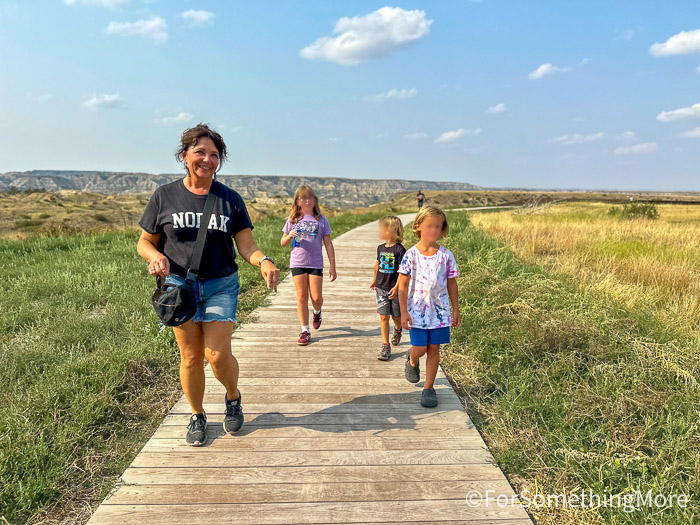
What About Food and Breaks?
Families should plan breaks around the needs of the group rather than waiting until younger kids or older family members are already tired.
Even though the Theodore Roosevelt Presidential Library is highly interactive, several hours of exhibits still require concentration.
With our group spanning from age 5 through grandparents, we had a particularly wide range of potential energy levels to consider.
A real break can be more useful than squeezing in another attraction.
This becomes especially important if you’re heading into Theodore Roosevelt National Park afterward. From an adult itinerary-planning perspective, a museum followed by a national park may look like two completely different activities. For a tired 5-year-old, however, it can still feel like one long day of being asked to keep going.
The same principle applies to a multigenerational group. Build breaks into your plans before somebody needs one urgently.
Is the Theodore Roosevelt Presidential Library Stroller-Friendly and Accessible?
Families who need a stroller or accessibility accommodations should verify current accessibility information directly with the library before visiting.
This is particularly important for multigenerational groups because accessibility can involve much more than whether a building technically accommodates wheelchairs.
Consider the needs of:
- Young children who may use a stroller
- Grandparents who prefer shorter walking distances
- Anyone who needs frequent opportunities to sit
- Family members with mobility limitations
- Anyone for whom outdoor surfaces or weather may affect comfort
The indoor exhibits and outdoor grounds also create different considerations.
A route that works comfortably inside doesn’t necessarily tell you what every outdoor area will be like. If accessibility is important to someone in your group, check specifically for the portions of the property you plan to explore rather than making assumptions.
How Should Families Plan Around the Weather?
Families should use the weather forecast to decide how much outdoor time to build around their Theodore Roosevelt Presidential Library visit.
One advantage of the library is that the substantial indoor experience gives you flexibility.
On a comfortable day, you can spend more time exploring the grounds. During extreme heat, strong wind, heavy rain, thunderstorms, or uncomfortable cold, you can shorten the outdoor portion without losing the primary indoor experience.
Weather also affects different generations differently.
Conditions that don’t bother an active teenager may be uncomfortable for a younger child or grandparent. When traveling as a multigenerational family, plan around the person who is most affected by the conditions rather than assuming everyone will be equally comfortable.
If you’re also visiting Theodore Roosevelt National Park, check the weather and park conditions together. You may find that changing the order of your day gives your family much better conditions for the outdoor portion.
Planning Takeaway
Plan the Theodore Roosevelt Presidential Library as both an indoor and outdoor experience, particularly if you’re visiting as a family with a wide range of ages.
Check current tickets and hours directly with the library, arrive when younger kids have enough energy to engage, dress everyone for the outdoor grounds, and leave some flexibility for breaks.
For our group of five kids ranging from 5 to 17, parents, and grandparents, flexibility mattered more than creating a tightly scheduled visit. Everyone did not need to move at the same pace or have exactly the same amount of energy for the day to work well.
Give yourself enough margin to follow genuine interest, slow down when someone needs a break, and spend time outside when the conditions cooperate. That little bit of flexibility becomes especially valuable when you’re experiencing the Theodore Roosevelt Presidential Library as a multigenerational family.
How Should Families Combine the Library With Theodore Roosevelt National Park and Medora?
Families should combine the Theodore Roosevelt Presidential Library with Theodore Roosevelt National Park and time in Medora because experiencing the surrounding Badlands gives kids—and adults—real-world context for much of what they learn inside the library.
For us, this connection was one of the strongest reasons the library worked so well as part of an outdoor family trip. We were traveling as a multigenerational group with five kids ranging from 5 to 17, plus grandparents, and the combination gave everyone opportunities to alternate between structured learning and time outside.
You can learn about Roosevelt’s years in the Dakota Badlands, his relationship with the outdoors, and the development of his conservation ideas inside the library. Then you can experience the broader landscape for yourself.
Should You Visit Theodore Roosevelt National Park After the Library?
Yes, Theodore Roosevelt National Park is the most natural outdoor experience to pair with the Theodore Roosevelt Presidential Library.
The South Unit entrance is in Medora, making the two particularly easy to combine as part of the same family trip.
More importantly, they complement each other.
Inside the library, kids learn why Roosevelt came to the Dakota Territory and how his experiences in the West influenced him. In the national park, the Badlands stop being something represented on screens, photographs, and exhibit panels.
Your family can actually experience the terrain, look for wildlife, walk through the landscape, and get a much better sense of the environment that played such an important role in Roosevelt’s life.
The National Park Service is the best source for current information about Theodore Roosevelt National Park, including road conditions, closures, hiking, wildlife, and safety information.
What Can Families Do in Theodore Roosevelt National Park?
Families can make their Theodore Roosevelt National Park experience as active or relaxed as their group’s energy allows, which makes it particularly useful when traveling with multiple generations.
You do not need to follow several hours at the library with a demanding hike.
Depending on your family’s energy, weather, and available time, you can focus on:
- Short family hikes
- Wildlife viewing
- Badlands overlooks
- Scenic driving
- Short stops where kids can get out and explore
- Longer hikes if everyone still has the energy
That flexibility is particularly important when your group includes both young children and grandparents.
Our 5-year-old and our 17-year-old nephew obviously did not have identical needs after spending several hours at the library. The same applies when comparing younger kids with grandparents.
Instead of deciding in advance that everyone must complete a particular hike, choose your park activities according to how the group is actually doing.
If everyone still has plenty of energy, get out on a trail. If some members of the family are tired, scenic stops, short walks, overlooks, and wildlife viewing can still give everyone meaningful time in the Badlands.
How Does Theodore Roosevelt National Park Reinforce What Kids Learn at the Library?
Visiting Theodore Roosevelt National Park gives kids a physical reference point for the landscape, wildlife, and conservation ideas they encountered inside the Presidential Library.
This is where combining the two experiences becomes more than a matter of convenience.
A younger child may not remember the details of Roosevelt’s time in the Dakota Territory, but they can understand that the Badlands they are exploring are connected to the landscape they just learned about inside.
Older kids, teenagers, adults, and grandparents can make deeper connections between Roosevelt’s experiences in North Dakota and the historical material presented at the library.
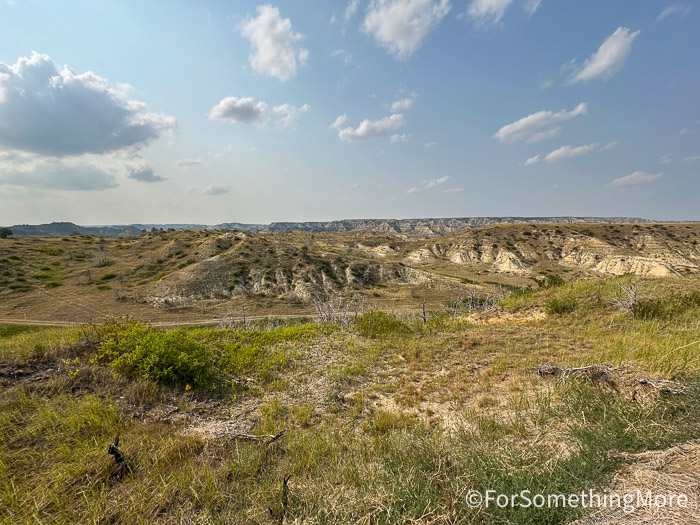
You do not need to turn your national park visit into another history lesson.
Simply experiencing the landscape provides useful context. Kids may remember seeing wildlife, walking through the Badlands, or standing at an overlook long after they have forgotten a particular date or exhibit panel.
What Else Should Families Do in Medora?
Families should leave some unscheduled time to experience Medora rather than moving directly from one major attraction to another.
Medora works particularly well as a base for exploring the surrounding Badlands, but you don’t need to fill every available hour.
That is especially true for a multigenerational group.
After several hours at an interactive museum and additional time outdoors, your 5-year-old, teenager, and grandparents may have very different opinions about whether the family needs another activity.
A meal, some downtime, or simply walking around Medora may be more useful than adding another attraction because you technically have room on the itinerary.
During the summer, long daylight hours can also make it tempting to keep going. Pay more attention to everyone’s actual energy than to how much daylight remains.
Should You Visit the Library or Theodore Roosevelt National Park First?
Either order can work, but families should make the decision based primarily on children’s energy, weather, and the needs of the overall group.
There is a strong argument for visiting the Theodore Roosevelt Presidential Library first.
Kids learn about Roosevelt and his relationship with the Badlands indoors, then experience that landscape with some context already established. Younger children may also have more attention available for the library earlier in the day.
However, weather can easily outweigh that advantage.
If the forecast calls for comfortable outdoor conditions in the morning followed by significant heat, strong winds, storms, or other less favorable conditions later, visiting the national park first may make considerably more sense.
For a multigenerational family, comfort matters too. A teenager may be perfectly happy hiking in conditions that are much less comfortable for a young child or grandparent.
One advantage of pairing these destinations is that the library gives you a substantial indoor experience while the national park is predominantly outdoors. That gives you room to adjust your plans rather than committing to one order regardless of conditions.
Should You Try to Do Everything in One Day?
Families can combine the Theodore Roosevelt Presidential Library, some time in Medora, and part of Theodore Roosevelt National Park in one day, but you should not expect to thoroughly experience everything on an aggressive schedule.
This is where the proximity of Medora’s major attractions can be misleading.
Short driving distances do not create additional energy.
For our multigenerational group, that distinction mattered. Five kids ranging from 5 to 17 plus grandparents meant we had a wide range of energy levels to consider even when everyone was enjoying themselves.
A substantial library visit, time exploring the grounds, and several hours in Theodore Roosevelt National Park already make for a full family day.
If you have more than one day available, use it.
Spreading the experiences out gives you more flexibility for hiking, wildlife viewing, weather, breaks, and the inevitable moments when someone simply needs downtime.
Planning Takeaway
Think of the Theodore Roosevelt Presidential Library and Theodore Roosevelt National Park as complementary parts of the same larger Medora experience.
The library provides historical context. The Badlands give your family an opportunity to experience the landscape that makes so much of Roosevelt’s North Dakota story easier to understand.
For our multigenerational family—with five kids ranging from 5 to 17, parents, and grandparents—that combination also provided a useful balance between learning indoors and exploring outside. Keep your national park plans flexible, choose activities according to the energy of the whole group, and resist the temptation to fill every available hour simply because Medora’s major attractions are close together.
What Is a Realistic One-Day Theodore Roosevelt Family Itinerary?
A realistic one-day Theodore Roosevelt family itinerary combines the Presidential Library, time outside on the library grounds, a genuine break, and flexible exploration of Theodore Roosevelt National Park rather than trying to fit every Medora attraction into a single day.
After experiencing the area as a multigenerational group with five kids ranging from 5 to 17, plus grandparents, we would build the day around flexibility rather than a tightly timed schedule.
The important part is recognizing that different generations may have very different amounts of energy as the day progresses. You can predict when you plan to arrive at the library; you cannot predict exactly how long your kids will spend at an interactive exhibit or how everyone will feel several hours later.
Morning: Start at the Theodore Roosevelt Presidential Library
Starting at the Theodore Roosevelt Presidential Library in the morning gives younger kids a chance to experience the exhibits while their attention and energy are relatively high.
For our family, the interactive nature of the library meant the kids were doing considerably more than following the adults around while we read museum displays. They were watching, listening, making choices, interacting with exhibits, and moving between very different environments.
Give yourself enough time to follow that interest.
If one of your kids spends 15 minutes somewhere you expected to spend five, that isn’t putting you behind schedule. It probably means the exhibit is working.
Likewise, don’t worry about moving relatively quickly through a section that isn’t holding a younger child’s attention while allowing older family members more time where practical.
With a multigenerational group, the goal shouldn’t be to keep everyone moving through every exhibit at exactly the same pace.
Late Morning: Explore the Library Grounds
Heading outside after the indoor exhibits gives everyone an opportunity to experience the Badlands setting while providing younger kids with a welcome change of pace.
This creates a natural transition in the day.
After spending the morning processing historical information, screens, sound, multimedia, and interactive exhibits, younger kids can move more freely. Older family members can slow down and experience the setting without immediately beginning another structured attraction.
Walk the paths, take in the surrounding landscape, and give the kids some time with the outdoor features.
There is no need to make this part highly structured.
If the weather is comfortable and everyone is enjoying being outside, stay longer. If the kids are hungry or someone in the group needs a break, move on.
Midday: Take a Real Break
Build genuine time for lunch and downtime before heading into Theodore Roosevelt National Park.
This may look like the least important part of the itinerary, but for a family spanning several generations, it can determine how enjoyable the second half of the day becomes.
A museum followed by outdoor exploration followed immediately by a national park can feel like one continuous activity to a young child.
The same principle applies to older family members. Someone may be enjoying the day and still benefit from an hour when they aren’t being asked to walk somewhere, look at something, or keep up with the rest of the group.
For our family, we would rather leave one additional activity off the itinerary than eliminate the break that allows everyone to enjoy what comes next.
Afternoon: Explore Theodore Roosevelt National Park’s South Unit
Spend the afternoon exploring the South Unit of Theodore Roosevelt National Park, choosing activities according to the weather, current park conditions, and your family’s actual energy.
The South Unit entrance is in Medora, making it the logical portion of the park to combine with the Presidential Library.
You do not need an ambitious afternoon plan.
If everyone still has plenty of energy, choose a family-friendly hike. If the younger kids or grandparents are beginning to tire, focus more on overlooks, wildlife viewing, scenic driving, and short walks.
This is one place where flexibility is considerably more useful than a checklist.
Our 5-year-old and 17-year-old nephew obviously weren’t operating with identical energy levels, and adding grandparents widened that range even further. Plan the afternoon for the group you actually have at that moment rather than the group you imagined when you created the itinerary.
Before entering the park, check current road conditions, closures, alerts, and visitor information through the National Park Service.
Late Afternoon: Choose a Short Hike or Wildlife Viewing
Let the group’s remaining energy determine whether the latter part of the afternoon becomes active or relaxed.
Theodore Roosevelt National Park does not require a long hike to be worthwhile.
Wildlife viewing, scenic stops, and Badlands overlooks can give everyone meaningful time in the landscape without committing the entire family to another substantial physical activity.
If the younger kids, teenager, adults, and grandparents are all still enthusiastic about hiking, take advantage of it.
If not, don’t force it.
One of the easiest ways to turn a successful multigenerational family day into an exhausting one is adding another activity because the itinerary says you have time rather than because everyone actually has the energy for it.
Evening: Return to Medora
Finish your day in Medora without assuming you need another major activity.
Have dinner, spend some relaxed time around town if everyone still wants to explore, or simply call it a day.
During periods with long daylight hours, it can feel as though you should keep going simply because there are still several hours of daylight available.
For a family with kids and grandparents, actual energy levels are a much more useful guide than the amount of daylight remaining.
If you’re spending multiple nights in Medora, there is even less reason to force another experience into the evening.
Planning Snapshot
A practical one-day family itinerary looks like this:
- Morning: Theodore Roosevelt Presidential Library indoor exhibits
- Late morning: Library grounds and outdoor exploration
- Midday: Lunch and genuine downtime
- Afternoon: Theodore Roosevelt National Park South Unit
- Late afternoon: Short hike, overlooks, scenic stops, or wildlife viewing
- Evening: Dinner and relaxed time in Medora
Treat these as blocks rather than appointments.
The library may take longer than expected. Weather may make the national park better in the morning. Your younger kids may want to spend more time outside the library than you anticipated. A grandparent may need a longer break.
Those adjustments do not mean your itinerary has failed.
They are exactly why building flexibility into a multigenerational trip is useful.
What If You Have Two Days in Medora?
Families with two days should consider separating the Theodore Roosevelt Presidential Library and the bulk of their Theodore Roosevelt National Park exploration rather than simply adding more attractions.
This is the option we would favor if your schedule allows it.
You can devote one day primarily to the library, its grounds, and Medora, then use the second for a more substantial national park experience.
That becomes particularly useful if your family wants to hike rather than primarily experience the park through overlooks, wildlife viewing, and scenic stops.
It also gives you more flexibility around weather and energy.
For a multigenerational group, the advantage isn’t simply that you can see more. You can experience what you do choose at a more comfortable pace.
Planning Takeaway
If you only have one day in Medora, prioritize the Theodore Roosevelt Presidential Library and Theodore Roosevelt National Park rather than trying to see everything the area offers.
Start with the library when younger kids are fresh, spend some time on the outdoor grounds, take a genuine midday break, and then let the energy of your entire group determine how ambitious you get in the national park.
For our multigenerational family—with five kids ranging from 5 to 17, parents, and grandparents—that balance between indoor learning, outdoor exploration, and flexibility is what makes the combination work. You don’t need every generation to experience the day in exactly the same way; you need enough room in the plan for everyone to enjoy it at a pace that works for them.
Final Thoughts – Theodore Roosevelt Presidential Library With Kids
After visiting the Theodore Roosevelt Presidential Library with five kids ranging from 5 to 17, along with grandparents, we think one of its biggest strengths is how naturally it works as a multigenerational family experience. If your family enjoys interactive learning, history, outdoor exploration, or simply finding experiences that can hold the interest of several different ages, visiting the Theodore Roosevelt Presidential Library with kids is well worth considering.
You don’t need everyone to move through the library at the same pace or connect with the same exhibits. Younger kids may spend more time with hands-on and immersive experiences, while teenagers, parents, and grandparents can engage more deeply with the historical material. For us, combining those different ways of learning with time outside in the North Dakota Badlands made the experience particularly well suited to the way our family likes to travel—and with a flexible pace, it’s a very manageable addition to a family trip to Medora.
FAQs – Theodore Roosevelt Presidential Library With Kids
- Q: Is the Theodore Roosevelt Presidential Library good for kids? A: Yes. We visited the Theodore Roosevelt Presidential Library with five kids ranging from 5 to 17, along with parents and grandparents, and found that it worked well across the different ages. Interactive technology, immersive exhibits, multimedia, historical content, and outdoor spaces give family members different ways to engage.
- Q: What ages are best for the Theodore Roosevelt Presidential Library? A: Based on our visit, there isn’t one narrow age range that works best. Our kids were 5, 7, 11, 11, and 17, and each age could engage with the experience differently. Younger kids are likely to gravitate toward interactive and visual exhibits, while older kids and teenagers can understand more of the historical context.
- Q: Is the Theodore Roosevelt Presidential Library good for a multigenerational family? A: Yes. We visited with five kids ranging from 5 to 17 as well as a set of grandparents, so our group covered a particularly wide age range. One of the library’s strengths is that younger kids, teenagers, parents, and grandparents can experience the same exhibits at different levels rather than needing completely separate activities.
- Q: How much time should families spend at the Theodore Roosevelt Presidential Library? A: We recommend planning several hours rather than treating the library as a quick museum stop. Interactive exhibits can hold kids’ attention longer than expected, older family members may want more time with detailed historical material, and you should also leave time to explore the outdoor grounds.
- Q: Is the Theodore Roosevelt Presidential Library interactive? A: Yes. One of the things that stood out during our visit was how frequently the kids could interact with exhibits rather than simply look at artifacts or read information. The library incorporates hands-on elements, technology, multimedia, and immersive environments throughout the experience.
- Q: Do kids need to know about Theodore Roosevelt before visiting? A: No. Our kids ranged from 5 to 17, and they did not need extensive knowledge of Theodore Roosevelt beforehand. The exhibits provide enough context to introduce his life, presidency, connection to North Dakota, conservation ideas, and broader legacy while allowing different ages to engage at their own level.
- Q: Is the Theodore Roosevelt Presidential Library interesting for teenagers? A: Yes. Having our 17-year-old nephew with us gave us firsthand experience visiting with a teenager as well as younger kids. Teenagers can still enjoy the interactive and immersive elements while also engaging more deeply with Roosevelt’s presidency, leadership, conservation, historical context, and legacy.
- Q: Are there things for kids to do outside the Theodore Roosevelt Presidential Library? A: Yes. Families can explore the outdoor grounds, walking paths, Badlands landscaping, and more active features for kids. We recommend leaving time for the outdoor portion because it gave our younger kids a chance to move after the indoor exhibits while helping everyone connect the library with the surrounding landscape.
- Q: Can you visit the Theodore Roosevelt Presidential Library and Theodore Roosevelt National Park on the same day? A: Yes. The Presidential Library and the South Unit of Theodore Roosevelt National Park can work well together in a one-day Medora itinerary. We would avoid rushing either experience, though, particularly with younger kids or a multigenerational group. Keep the national park portion flexible according to everyone’s energy and the weather.
- Q: Should families visit the Theodore Roosevelt Presidential Library or Theodore Roosevelt National Park first? A: Visiting the library first can work particularly well because kids learn about Roosevelt’s relationship with the Dakota Badlands before experiencing that landscape in the national park. However, weather and your family’s energy may make visiting the park first a better choice on some days.
- Q: Is the Theodore Roosevelt Presidential Library worth visiting if your kids don’t like history? A: Yes, particularly if your kids enjoy interactive museums, technology, nature, wildlife, or learning by doing. Our five kids ranged considerably in age, and the experience does not depend on children already being Theodore Roosevelt enthusiasts or wanting to read every historical display.
- Q: What should kids wear to the Theodore Roosevelt Presidential Library? A: Dress kids for both indoor exhibits and outdoor exploration. Comfortable walking shoes, seasonally appropriate layers, sun protection, and clothing suitable for moving around outside make it easier to enjoy the entire experience. Multigenerational groups should also consider the outdoor comfort and mobility needs of older family members.
- Q: Where is the Theodore Roosevelt Presidential Library? A: The Theodore Roosevelt Presidential Library is in Medora, North Dakota, in the state’s western Badlands. Its location makes it particularly easy to combine with Theodore Roosevelt National Park and a broader family trip to Medora.
- Q: How many days should families spend in Medora? A: You can combine the Theodore Roosevelt Presidential Library with some exploration of Theodore Roosevelt National Park in one full day, but we prefer the flexibility of having two days if your schedule allows it. That gives families more room for hiking, wildlife viewing, weather changes, downtime, and different energy levels across a multigenerational group.
+++BEFORE using this information, please read our Legal Disclaimer+++